
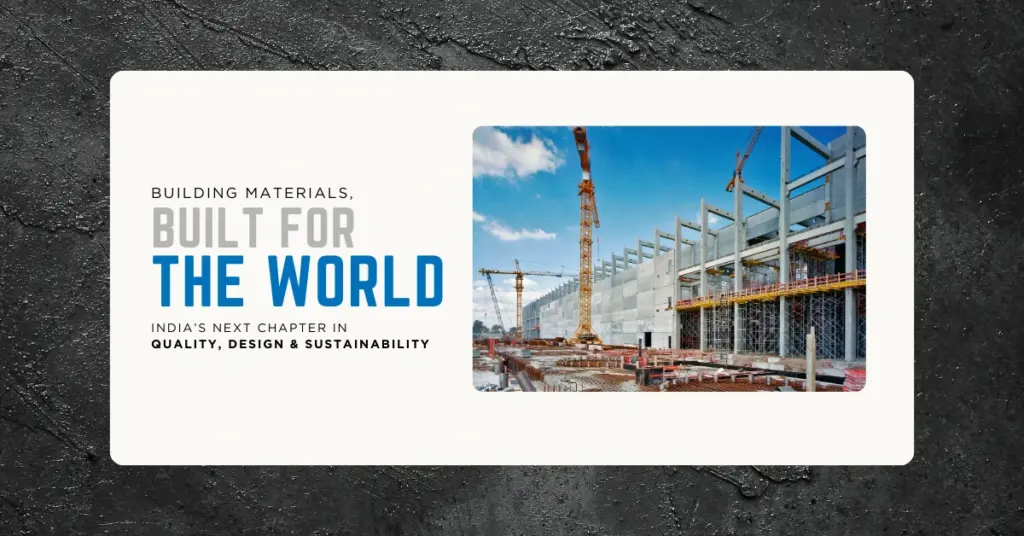
Building Materials, Built for the World: India’s Next Chapter in Quality, Design & Sustainability
February 12, 2026

As India steps into its Amrit Kaal, the transformative 25-year journey leading up to the centenary of independence, the nation’s growth blueprint is clear: create infrastructure that is not just vast in scale, but exceptional in quality, future-ready in design, and sustainable at its core. From 100 smart cities and high-speed rail corridors to industrial hubs, logistics parks, and climate-resilient urban networks, the scale of ambition is unprecedented. This is not merely construction; it is the deliberate shaping of a new India that can stand shoulder-to-shoulder with the most advanced economies in the world. India’s aspirations to become a $10 trillion economy are closely tied to its ability to execute infrastructure at speed, scale, and sustainability. The ₹11 lakh crore capital expenditure allocation in the Union Budget 2025–26, alongside landmark programmes like PM Gati Shakti, Bharatmala, and the National Infrastructure Pipeline, reflects this urgency. But the real measure of progress lies not in the kilometres built or projects completed, it lies in whether we build infrastructure that will endure for generations, deliver operational efficiency, and adapt to changing climate realities.
The building materials sector is at the heart of this transformation. Once seen as a peripheral contributor, it is now a strategic enabler of national competitiveness. Today, the idea of “quality” in building materials goes far beyond sheer strength or cost efficiency. It is about creating solutions that conserve energy, last longer, withstand climate stresses, and adapt to the unique conditions of each region. From precision-engineered Ready-Mix Concrete (RMC) that accelerates construction timelines, to large-format tiles that improve hygiene and durability, to cool-roof and high-performance façade systems that combat heat stress, these innovations are setting new benchmarks. By embedding such advanced materials into every project, India is not just building faster, it is building smarter and more sustainably for the long term.
India’s architectural heritage, has always reflected an intuitive understanding of local climate and materials. The need of the hour is to replicate this harmony using cutting-edge science, AI-led design simulations, and climate-resilient engineering. Bioclimatic design principles, enhanced with modern materials and smart sensors, are enabling energy efficiency and occupant comfort. AI and Machine Learning are optimising concrete mixes for site-specific needs, predicting material performance, and minimising waste through generative design.
Building Information Modelling (BIM) and digital twins allow architects, engineers, and developers to visualise entire projects before a single brick is laid, reducing design errors, streamlining collaboration, and improving lifecycle asset management. Supply chains are also undergoing a digital revolution. QR-coded traceability, blockchain-enabled quality certifications, and real-time inventory monitoring ensure transparency and accountability, critical factors for large-scale infrastructure projects. India’s geographic and climatic diversity demands a context-sensitive approach to material innovation. Moisture-resistant products for coastal regions, heat-reflective surfaces for central plains, and impact-resistant solutions for seismic zones are becoming the norm. This regional R&D approach allows Indian manufacturers to meet global quality benchmarks while remaining deeply relevant to local needs.
Such innovation is not only enhancing domestic projects but also strengthening India’s position as a trusted supplier in global construction supply chains, a competitive advantage in a post-tariff, globalised market. Government frameworks such as GRIHA, IGBC, and the Energy Conservation Building Code (ECBC) are aligning infrastructure goals with sustainability imperatives. Public-private partnerships, combined with academic research, are accelerating advancements in green materials, circular construction, and workforce upskilling. At Aparna Unispace, these learnings translate into interiors that blend global design, sustainable materials, and uncompromising quality, offering solutions that are both environmental friendly and contemporary. Yet, the road ahead requires coordinated action: standardised quality benchmarks, mandatory certifications, incentives for sustainable material adoption, and climate resilience built into all public and private infrastructure tenders.
By 2030, over 500 million Indians will live in cities. Meeting their needs will require infrastructure that delivers on speed, strength, sustainability, and scale. This is not just about constructing buildings; it is about constructing a resilient legacy. For stakeholders across the ecosystem, architects, developers, policymakers, and manufacturers, the mandate is clear: we must elevate quality as the non-negotiable foundation, harness innovation to optimise resources and performance, and embed responsibility into every project to ensure longevity and climate resilience.Today, India has the opportunity to redefine what building materials can achieve, not just for the domestic market, but for the world. The choices we make today will determine whether we build infrastructure that merely meets demand, or infrastructure that inspires confidence, competitiveness, and pride for generations to come.