
What Is Glass Fiber Reinforced Concrete (GFRC)? Properties, Uses & Benefits
July 21, 2026
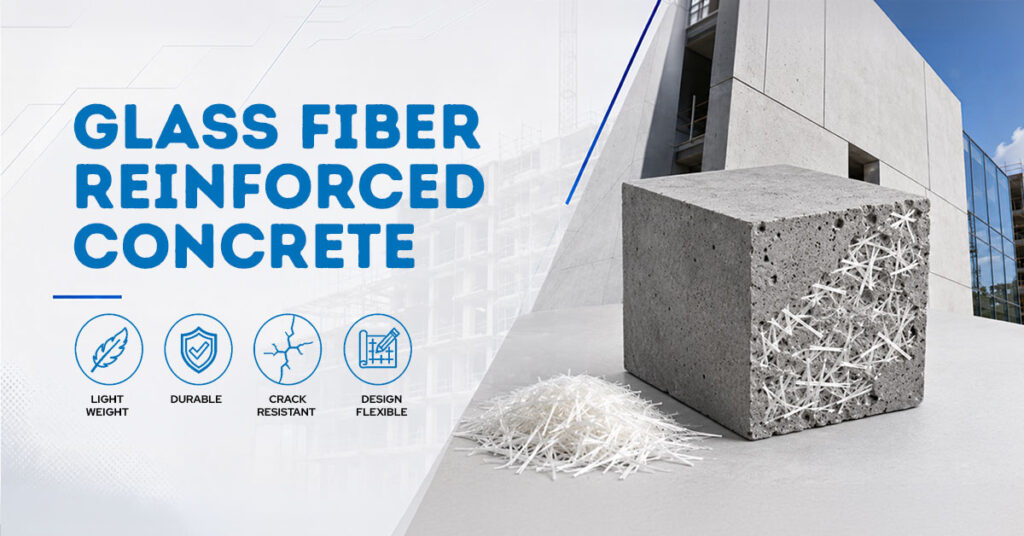
Glass Fibre Reinforced Concrete (GFRC) is a cement-based composite, reinforced with alkali-resistant glass fibres instead of steel. The finished GFRC panel weighs up to 75% less than an equivalent precast panel because of using glass fibres instead of steel, making it lighter.
It resists cracking and can be moulded into thin, complex shapes. So, it is widely used as a finishing and architectural material rather than a structural one. Its applications include facades, cladding, jaali, mouldings, and decorative elements.
GFR concrete is preferred where weight, mouldability, and surface finish are important. Aparna RMC manufactures GFRC/GRC for facade, cladding, and architectural applications by applying a consistent mix design and quality control to every batch.
This special concrete was first developed in the 1940s, but it was widely used practically in the 1970s, after alkali-resistant glass fibre was invented.
What is the Difference Between GRC vs GFRC vs GFRP?
GRC (Glass Fibre Reinforced Concrete) and GFRC (Glass Fiber Reinforced Concrete) are two names for the same material – a cement-based composite with AR glass fibre. GFRP (Glass Fibre Reinforced Plastic) is a polymer-based composite. Though they both use glass fibers, their base materials and primary construction applications vary.
Material |
What It Actually Is |
Same as GFRC? |
| GRC/GFRC | The Indian/British name for glass-fibre reinforced concrete (cement matrix + AR glass fibre) | Yes |
| GFRP/FRP | Glass fibre in a polymer (plastic) matrix, not cement | No |
What Is GFRC Made Of?
Glass fibre reinforced concrete consists of these five main ingredients:
- Portland cement
- Fine sand
- Alkali-resistant (AR) glass fibre
- Acrylic polymer + admixtures
- Water
Component |
Role |
Typical Proportion |
| Portland cement | Binder/matrix | ~1:1 cement-to-sand (fine aggregate) ratio |
| Fine sand/aggregate | Body & surface finish | ~1:1 with cement |
| Alkali-resistant (AR) glass fibre | Reinforcement (replaces steel) | 1–3% of total mix weight (2–5% of total mix weight for traditional spray-up methods, and 2–3% for premixed casting methods.) |
| Acrylic polymer + water + admixtures | Curing, flexibility, shrinkage control | Per manufacturer’s dosage (Dosage optimized as specified by the chemical manufacturer). |
Regular glass fibres get destroyed in the alkaline environment inside concrete. Alkali-Resistant (AR) glass fibres do not degrade in highly alkaline concrete environments, which ensures long-term panel durability)
GFRC is produced by spraying the cement-fibre slurry onto a mould (spray-up) or by premixing fibre into the slurry before pouring.
Properties of GFRC
The integrated matrix of glass fibres renders GFRC tough, flexible, and exceptionally lightweight, resulting in a durable, impact-resistant material with superior fire and weather resistance ) The table below lists the properties of GFRC:
Property |
Typical Value |
| Density | Equivalent to approximately 19–21 kg/m² for a 10 mm panel profile |
| Compressive strength | 40–80 MPa |
| Flexural strength | 10–30 MPa |
| Tensile strength | 4–7 MPa (equivalent to 580–1,015 psi)* |
| Panel thickness (typical) | 8–20 mm (vs ~40 mm+ for precast) |
| Dead load comparison to conventional panels | Up to 75% lighter |
| Fire rating | Classified as A1 or A2 non-combustible material based on composition. |
| Lifespan | Comparable to precast concrete when correctly made & installed |
Advantages of Glass Fibre Reinforced Concrete
Beyond its lightweight nature, GFRC offers high tensile capacity, micro-crack mitigation, architectural flexibility, and extreme environmental resilience.
- High strength-to-weight ratio: The high flexural and tensile capacities derived from the internal glass-fibre network actively resist structural micro-cracking during dynamic loading and seismic events.
- Thinness & Mouldability: The composite can be precision-cast down to cross-sections of 8–15 mm into complex architectural geometric configurations, including structural domes, jaalis, ornamental cornices, and premium cladding panels. )
- Low Permeability and Environmental Resistance: Its tightly packed microstructure exhibits exceptionally low permeability, effectively blocking moisture and gas ingress to withstand severe UV exposure, freeze-thaw cycles, and extreme marine conditions.)
- Inherent Fire Performance: GFRC is completely non-combustible due to its inorganic, cementitious matrix, which provides excellent thermal insulation and prevents flame spread. The minor percentage of acrylic polymer required for curing is entirely encapsulated within the dense matrix and does not degrade the fire rating.
- Architectural Versatility: The material can be fully customized across any pigment, aggregate texture, or surface finish, allowing it to mimic natural stone or timber for facades, urban planters, and bespoke elements.
- Ecological Sustainability: The severe reduction in component thickness translates directly to a lower raw material footprint per square meter, drastically curbing total embodied carbon and reducing transport-associated emissions.
Disadvantages of GFRC
- Elevated Raw Material Costs: The unit cost per kilogram is higher than that of conventional concrete due to the inclusion of premium Portland cement, acrylic polymers, and specialized AR glass fibres.
- Structural Limitations: GFRC is strictly engineered for non-load-bearing elements—such as architectural cladding, facades, and decorative panels—and cannot be used as a primary structural member to support dead or live building loads.
- Process Sensitivity: The mechanical properties are highly sensitive to manufacturing precision; methods like simultaneous spray-up demand specialized equipment and certified, skilled labour to guarantee structural uniformity.
- Long-Term Degradation Risks: Inadequate hydration curing cycles or the accidental substitution of standard glass fibres for true AR filaments will cause a severe loss of tensile capacity over time )
- Recycling Challenges: The integrated acrylic polymer content makes cured GFRC more complex to recycle compared to plain, unmodified concrete aggregates )
- Post-Curing Modification Constraints: Cured panels are highly brittle and difficult to field-cut or core-drill post-hydration without causing edge delamination, micro-cracking, or fibre fraying.
- Crazing and Aesthetics: Improper batching or sudden thermal shifts can induce fine hairline surface cracks (crazing) over time, which compromises the architectural finish.
Where Is GFRC Used?
GFRC is primarily deployed for non-structural architectural systems where high strength-to-weight ratios and strict aesthetic parameters are required. Standard applications include the following systems:
- Building Facades & Cladding: Lightweight external building envelopes optimized for high-rise installations.
- Jaali / Elevation Screens: Highly detailed, perforated architectural screens utilized for decorative exterior elevations.
- Architectural Mouldings: Complex geometric features including cornices, column capitals, structural domes, and window architraves.
- Countertops & furniture — thin, mouldable interior surfaces
- Urban Landscape Architecture: Weather-resistant external furniture, including public benches, commercial planters, and water features.
Aparna RMC supplies engineered concrete solutions for facade, cladding, and architectural applications like these.
Key Takeaways
GFRC (glass fibre reinforced concrete) is a cement composite reinforced with alkali-resistant glass fibre instead of steel
- It is up to 75% lighter than precast concrete
- It is strong, crack- and fire-resistant, and freely mouldable
- GFRC is optimized for building skins and decorative components; it is completely restricted from primary structural load-bearing member design.
Glass Fibre Reinforced Concrete provides architects and structural engineers with the authentic aesthetic of stone or solid concrete at a fraction of the structural dead weight, driving design freedom for modern external envelopes, open-work screens, and complex detailing)
Planning a project that needs GFRC or GRC? Aparna RMC manufactures engineered, quality-controlled concrete solutions for facade, cladding, and architectural applications. Talk to our team about your requirements.
Frequently Asked Questions On GFRC
How long does GFRC last?
GFRC can last for over 50 years. When properly designed, it can exceed the lifespan of natural stone and conventional concrete. Because it contains zero structural carbon steel, it is entirely immune to chloride-induced corrosion and rust-expansion cracking in humid or coastal microclimates, significantly extending its service life.
Is GFRC Impermeable?
GFRC exhibits exceptionally high water resistance but is classified as hydro-resistant rather than absolutely waterproof.
Does GFRC crack?
GFRC is more resistant to cracking when compared to precast concrete because fibre arrests microcracks. It can still crack under severe stress, poor curing, or structural movement.
What is the Fire Performance Rating of GFRC?
GFRC offers good resistance to fire because it is non-combustible. But it can degrade at extreme heat over long periods. Also, GFRC wall systems prevent fire penetration for up to two hours.
What is the difference between GFRC and conventional precast concrete?
GFRC utilizes a high-volume matrix of alkali-resistant glass fibres in place of heavy carbon steel reinforcing bars, enabling significantly thinner profiles and a drastic reduction in dead weight)
Categories
Recent Posts
- M20 Concrete Ratio: Mix Proportion, Material Calculation and Uses
- Steel Fiber Reinforced Concrete (SFRC): Types, Properties, Dosage & Applications
- M10 Concrete Ratio: Mix Proportion, Quantities and Uses
- How Ready Mix Concrete Is Made: The RMC Manufacturing Process, Step by Step
- What Is Ready Mix Concrete? A Complete Guide to RMC in Construction
Connect with us