
M10 Concrete Ratio: Mix Proportion, Quantities and Uses
September 21, 2026
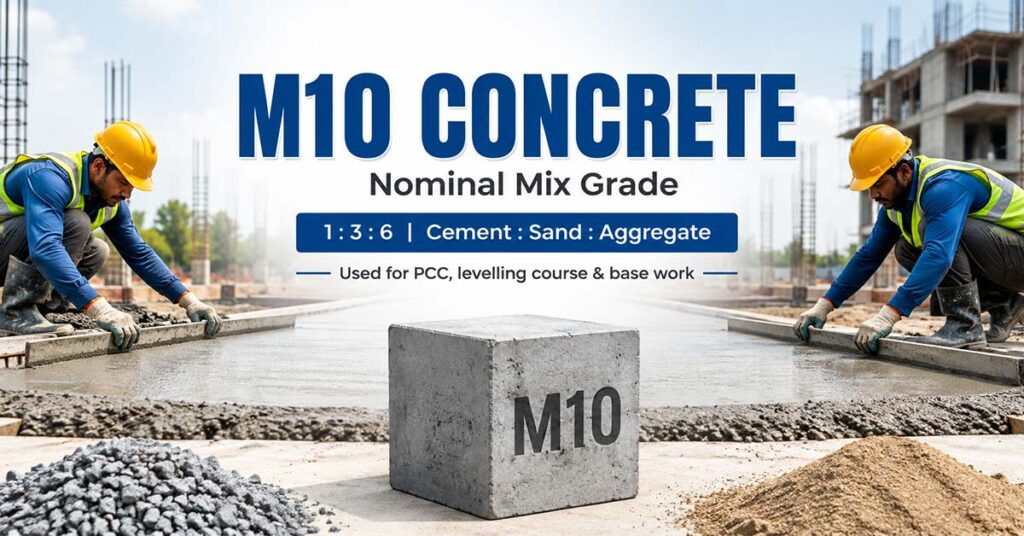
M10 concrete has a nominal mix ratio of 1:3:6, meaning 1 part cement, 3 parts sand, and 6 parts coarse aggregate by volume. It has a characteristic compressive strength of 10 MPa (10 N/mm²) at 28 days and is mainly used for non-structural plain cement concrete (PCC) applications such as blinding, levelling courses and flooring bases. One cubic metre requires approximately 4.4 bags of 50 kg cement.
Note: M10 also refers to a 10 mm metric bolt or screw thread. This page covers the M10 concrete grade only.
Key Takeaways
- The M10 mix ratio is 1:3:6 (cement : sand : coarse aggregate), by volume.
- Characteristic compressive strength is 10 MPa (10 N/mm²) at 28 days.
- One cubic metre of M10 concrete needs about 4.4 bags of cement (not 8 — that figure belongs to M20).
- M10 is a PCC-only grade and is not permitted for reinforced concrete (RCC).
- Mainly foundation blinding, levelling courses, flooring bases, pathways and drain bedding.
This guide covers what M10 Grade Concrete Is, and its ratio, strength, water-cement ratio, workability, density, uses, and comparison with other grades.
What Is M10 Grade Concrete?
M10 grade concrete is a low-strength, non-structural concrete mix with a characteristic compressive strength of 10 N/mm² (10 MPa) measured on a standard cube at 28 days. It is one of the leanest concrete grades, so it is not specified for carrying structural load.
What Does M10 Mean?
In the “M10” designation, M stands for Mix, and 10 is the characteristic compressive strength in N/mm² that the concrete must achieve after 28 days of curing.
For reference, 1 N/mm² is equal to 1 MPa, so M10 concrete and ‘10 MPa concrete’ mean the same thing.
Why M10 Is Called a Lean Mix?
M10 is called a lean mix because it contains a relatively high proportion of aggregate compared with cement. Its lower cement content makes it economical for applications where high structural strength is not required.
M10 Concrete Ratio: 1 : 3 : 6
The standard M10 concrete mix ratio is 1 : 3 : 6 — 1 part cement, 3 parts sand (fine aggregate), and 6 parts coarse aggregate. Put together, that’s 10 total parts.
What the Ratio Means?
For every unit of cement used, you add three equivalent units of sand and six equivalent units of coarse aggregate, measured by volume. This proportion gives M10 its target strength of 10 MPa at 28 days when mixed with a suitable water-cement ratio.
Is the M10 Ratio by Volume or by Weight?
The 1:3:6 ratio is by volume, not by weight. On site, this is typically measured using standard-sized boxes or gauge boxes for consistency, rather than weighing each material separately. To convert volume into weight requires applying the bulk density of each material, which is exactly what the quantity calculation below does.
M10 Is a Nominal Mix, Not a Design Mix
IS 456:2000 permits nominal (fixed-ratio) mixes for grades up to and including M20. Because M10 falls within the grades for which IS 456 permits nominal mixes. The standard 1:3:6 proportion is therefore used as the nominal mix ratio, rather than being treated as a project-specific design mix.
Nominal mix ratios by grade
The table outlines the standard nominal mix ratios and total parts for different grades of concrete.
| Grade | Ratio (Cement : Sand : Aggregate) | Total Parts |
|---|---|---|
| M5 | 1 : 5 : 10 | 16 |
| M7.5 | 1 : 4 : 8 | 13 |
| M10 | 1 : 3 : 6 | 10 |
| M15 | 1 : 2 : 4 | 7 |
| M20 | 1 : 1.5 : 3 | 5.5 |
M10 Concrete Quantities Per Cubic Metre
Here is a step-by-step calculation of the cement, sand, aggregate, and water required for one cubic metre of M10 concrete.
List per 1 m³
- Cement:4 Bags (50kg each)
- Sand:3 Cubic Feet (cft)
- Stones:6 Cubic Feet (cft)
- Water: 111 to 133 Litres
The 3-Step Math Breakdown
- The Shrinkage Rule: Materials shrink when mixed, so you need 1.54 m³ of dry mix (raw cement powder, dry sand, and unmixed gravel/stones before any water is added) to make 1 m³ of wet concrete.
- The 10-Part Recipe: M10 concrete uses a 1:3:6 ratio, totaling 10 parts (1 cement + 3 sand + 6 stones).
- The Final Shares: Divide the 1.54 m³ dry mix into 10 shares:
- Cement (1 share): Equals 4.4 bags
- Sand (3 shares): Equals 16.3 cubic feet
- Stones (6 shares): This is twice the sand quantity in the 1:3:6 M10 nominal mix, giving 32.6 cubic feet.
| Material | Parts | Volume (cft) | Quantity |
|---|---|---|---|
| Cement | 1 | 5.4 | 4.4 Bags |
| Sand | 3 | 16.3 | 16.3 cft |
| Stones | 6 | 32.6 | 32.6 cft |
| Water | — | — | 111–133 Litres |
How Many Cement Bags for M10 Concrete?
You need about 4.4 bags of 50 kg cement per cubic metre of M10 concrete, based on the standard 1:3:6 ratio and a 1.54 dry-volume conversion factor.
Quantities for Common Volumes
The data provided corresponds to a standard 1 : 3 : 6 nominal mix proportion (Cement : Sand : Aggregate) for M10 grade concrete.
M10 Nominal Proportion Table
| Material | Mix Ratio (by Volume) | Quantity per 1 Bag of Cement (50 kg) |
|---|---|---|
| Cement | 1 part | 1 Bag (approx. 1.23 cft / 35 Litres) |
| Sand | 3 parts | 3.7 cft |
| Aggregate | 6 parts | 7.4 cft |
| Water | 0.5–0.6 (Water-Cement ratio) | 25–30 Litres |
M10 Concrete Strength (Compressive Strength)
M10 concrete is designed to reach a characteristic compressive strength of 10 MPa (10 N/mm²) when tested on a standard cube after 28 days of curing.
Strength Gain Over Time
| Curing Period | Approx. Strength | % of Strength |
|---|---|---|
| 1 day | 1.6 MPa | 16% |
| 3 days | 4.0 MPa | 40% |
| 7 days | 7.0 MPa | 70% |
| 14 days | 9.0 MPa | 90% |
| 28 days | 10.0 MPa | 100% |
Is M10 Tested?
Concrete strength is usually tested at 7, 14, and 28 days, but small sites rarely test M10 concrete because it is only used for simple, non-structural tasks like levelling. Larger projects using M10 for sub-base or bedding work may still specify testing as part of quality control.
Water-Cement Ratio and Workability
- Water-Cement Ratio for M10: The water cement ratio for M10 concrete falls between 0.50 and 0.60. IS 456:2000 caps the water-cement ratio for plain concrete at 0.60 under mild exposure conditions. In litres, this works out to roughly 111–133 litres per cubic metre.
- Slump for M10: M10 concrete requires a 25–75 mm slump because it is manually placed and compacted for leveling, unlike structural concrete, which must flow through dense reinforcement.
- Curing: M10 concrete should be properly cured to support strength development. For OPC-based concrete, a minimum curing period of 7 days is generally specified, while blended cement and hot or dry conditions may require longer curing.
M10 Concrete Density and Weight
M10 concrete weighs 2,200–2,400 kg/m³ (2.2–2.4 tonnes), which is slightly lighter than higher grades due to less cement and more aggregate.
Where M10 Concrete Is Used?
- M10 for PCC (Plain Cement Concrete): The standard choice for low-cost, unreinforced, non-structural concrete due to its low strength.
- Foundation Blinding and Levelling Courses: M10 is commonly laid as a thin blinding layer (50–100 mm thick) beneath footings and foundations, providing a clean, level working surface before reinforcement and formwork go in.
- Flooring Bases and Sub-Bases: M10 serves as a sub-base or base layer under flooring, giving a stable, even foundation for finished floor layers above it.
- Pathways, Drain Bedding and Non-Load-Bearing Fill: Provides a hard, stable surface for garden pathways, drainage pipe bedding, and general fill where strength is not required.
Where M10 Must NOT Be Used?
M10 concrete must not be used for reinforced concrete (RCC) work, which means that M10 should never be used for:
- Slabs
- Beams or columns
- Any footing or foundation element that carries structural load
- Water-retaining structures
M10 Concrete for Plain Concrete as per IS 456:2000
| Exposure Condition | Min. Cement Content | Max. Water-Cement Ratio | Min. Grade |
|---|---|---|---|
| Mild | 220 kg/m3 | 0.60 | M10 |
| Moderate | 240 kg/m3 | 0.60 | M15 |
| Severe | 250 kg/m3 | 0.50 | M20 |
At the standard 1:3:6 ratio, M10 delivers approximately 221.8 kg/m³ of cement, which is just above the 220 kg/m³ minimum specified by IS 456 for plain concrete under mild exposure.
Under moderate exposure, the minimum cement content rises to 240 kg/m³, which the nominal M10 (1:3:6) no longer satisfies. In moderate exposure conditions, M15 becomes the minimum practical grade for plain concrete work.
Standards referenced: IS 456:2000, IS 10262:2019, IS 383:2016.
M10 vs Other Concrete Grades
| Grade | Ratio (Cement : Sand : Stone) | Best Use |
|---|---|---|
| M5 | 1 : 5 : 10 | Dirt barrier, filling |
| M7.5 | 1 : 4 : 8 | Cheap foundation base |
| M10 | 1 : 3 : 6 | Ground leveling mat |
| M15 | 1 : 2 : 4 | Walkways, kerbs |
| M20 | 1 : 1.5 : 3 | House pillars, beams, slabs (with steel) |
| M25+ | Design mix | High-rises, bridges |
M10 vs M15 vs M20: Which Should You Use?
- M10: Best for light-duty, non-load-bearing PCC work such as blinding, levelling courses and flooring bases.
- M15: Suitable where higher strength or moderate-exposure requirements make M10 unsuitable.
- M20: Minimum grade generally specified for reinforced cement concrete (RCC), including structural slabs, beams and columns, as per IS 456.
M10 Concrete Rate and Cost
M10 is a low-cement, economical concrete grade, requiring around 4.4 bags of cement per cubic metre compared with roughly 8 bags for M20. M10 is commonly used for blinding layers, levelling courses, flooring bases and pathway bedding where high structural strength is not required. Ready mix rates vary depending on raw material costs, transportation distance, location, and order quantity.
Aparna RMC supplies ready mix concrete across its network of plants in India. Contact the team to confirm M10 availability, minimum order quantity and pricing for your location.
Frequently Asked Questions On M10 Concrete
The M10 concrete ratio is 1:3:6 — 1 part cement, 3 parts sand, and 6 parts coarse aggregate, measured by volume.
Approximately 4.4 bags of 50 kg cement per cubic metre. This is often confused with the 8-bag figure, which applies to M20, not M10.
M10 grade concrete approximates a nominal mix ratio of 1:3:6 by volume, giving a target compressive strength of 10 MPa at 28 days.
M10 is used mainly for plain cement concrete (PCC) work — foundation blinding, levelling courses, flooring bases, pathways and drain bedding.
M10 is not suitable for structural reinforced-concrete slabs. It is a non-structural PCC grade and should not be used where the concrete is required to carry structural loads.
M10 concrete may develop a significant portion of its 28-day strength by 7 days. The exact strength depends on the cement type, curing conditions and mix. The specified characteristic compressive strength of M10 is 10 MPa at 28 days.
The water-cement ratio for M10 is typically 0.50 to 0.60, which determines how much water you mix with the cement to achieve the right strength and workability.
As per Indian Standard IS 456:2000, concrete grades up to M20 can use standard pre-set proportions (nominal mix) rather than expensive laboratory designs because their strength requirements are low.
The PCC M10 ratio is the same as the standard M10 ratio: 1:3:6 (cement : sand : coarse aggregate) by volume. This mix achieves a compressive strength of 10 MPa (N/mm²) after 28 days of curing.
Categories
Recent Posts
- M10 Concrete Ratio: Mix Proportion, Quantities and Uses
- How Ready Mix Concrete Is Made: The RMC Manufacturing Process, Step by Step
- What Is Ready Mix Concrete? A Complete Guide to RMC in Construction
- Fiber Reinforced Concrete (FRC): Types, Properties, Dosage and Applications
- Dry Mix Concrete: Grades, Quantity, Site Use and When to Choose It
Connect with us