
M20 Concrete Ratio: Mix Proportion, Material Calculation and Uses
September 26, 2026
M20 concrete has a characteristic compressive strength of 20 MPa at 28 days. The commonly used nominal proportion is 1:1.5:3 for cement, fine aggregate, and coarse aggregate by volume. For design-mix or ready-mix concrete, actual quantities depend on the approved mix design and project requirements.
Key takeaways
- The commonly used M20 ratio, 1:1.5:3, is measured by volume. The same ratio cannot be used directly by weight.
- M20 is specified to have a characteristic compressive strength of 20 N/mm², or 20 MPa, at 28 days.
- In the example below, one cubic metre requires an estimated 403.2 kg of cement, which works out to 8.06 bags of 50 kg each.
- Use water as per the approved mix. A water-cement ratio of 0.50 works out to 25 litres for 50 kg of cement, before adjusting for moisture.
- M20 can be made as a nominal mix or a design mix, depending on the specification followed.
What Is M20 Grade Concrete?
M20 tells you the strength grade of concrete. It refers to the specified characteristic compressive strength at 28 days. The grade does not tell you which cement brand or aggregate source has been used, or how the concrete has been produced.
What Does M20 Mean?
In M20, M stands for mix, and 20 refers to a characteristic compressive strength of 20 N/mm² at 28 days. Since one N/mm² is equal to one MPa, this can also be written as 20 MPa, or about 2,900 psi.
Both plant-produced concrete and concrete mixed at the site can be specified as M20. To decide whether the concrete is suitable, the approved proportions, material quality, production control, placing method, and test results all need to be considered.
What Is Characteristic Strength?
Characteristic strength means the strength below which no more than 5% of test results are expected to fall. This allows for variation in the results. It does not mean that every concrete cube will show exactly the same strength.
For this reason, the average strength aimed for during production is kept above the grade value. This extra margin allows for the normal differences between batches.
M20 Concrete Ratio: 1:1.5:3
The 1:1.5:3 ratio means one part cement, 1.5 parts sand and three parts coarse aggregate by volume. It is a commonly used nominal proportion; actual RMC quantities depend on the approved mix design.
| Material | Parts by volume | Meaning |
|---|---|---|
| Cement | 1 | One measured volume |
| Fine aggregate, such as suitable sand | 1.5 | One-and-a-half matching volumes |
| Coarse aggregate | 3 | Three matching volumes |
| Total | 5.5 | Combined loose ingredient volumes |
Measure all the ingredients on the same basis. You cannot directly compare a bag of cement with a bucket of sand and a pile of aggregate that has not been measured.
Is the M20 Ratio by Volume or Weight?
The 1:1.5:3 ratio is measured by volume. It does not mean mixing 1 kg of cement with 1.5 kg of sand and 3 kg of aggregate. Each material has a different bulk density, so the proportions by weight will be different.
If the materials are being batched by weight, follow the quantities given in the approved mix. Even for a basic conversion from volume to weight, you need the measured bulk density of each material. Also check damp sand, as moisture can increase its measured volume and add water to the concrete mix.
M20 Nominal Mix vs Design Mix
IS 456:2000 allows nominal mixes for M20 and lower grades. This table gives aggregate quantities by mass for a given quantity of cement. So, the usual volume ratio does not cover all the code requirements. Design mix concrete is preferred.
| Requirement | M20 |
|---|---|
| Cement basis | 50 kg |
| Maximum total dry aggregate | 250 kg |
| Fine aggregate : coarse aggregate | Generally 1:2 by mass* |
| Maximum water | 30 litres |
Note: The fine-to-coarse aggregate proportion can be adjusted between 1:1.5 and 1:2.5 depending on the grading of fine aggregate and the maximum size of coarse aggregate. For Zone II fine aggregate, IS 456 gives 1:1.5, 1:2 and 1:2.5 for 10 mm, 20 mm and 40 mm maximum aggregate sizes respectively.
| Comparison | Nominal mix | Design mix |
|---|---|---|
| Proportioning | Prescribed requirements and conventional proportions | Developed using actual materials and trial mixes |
| Material variation | Requires checks and adjustments | Assessed during proportioning and trials |
| Water requirement | Controlled within applicable limits | Selected for strength, durability and workability |
| Quality control | Still requires proper batching and testing | Uses defined production and testing controls |
| Cost | Depends on materials, labour and control | Can optimise materials for specified performance |
A design mix is useful when the concrete has to be pumped, travel for a certain time or pass through closely spaced reinforcement. It also helps when the project has specific durability requirements.
M20 Concrete Ratio for 1 Cubic Metre Using 1:1.5:3 - Example Calculation
Suppose you need 1 m³ of M20 concrete.
This is an example based on the 1:1.5:3 nominal ratio. Actual RMC quantities depend on the approved mix design.
Step 1: Calculate Dry Volume
Dry volume = 1 × 1.54 = 1.54 m³
Step 2: Add the Ratio
1 + 1.5 + 3 = 5.5
Step 3: Calculate Each Material
Cement:
(1 ÷ 5.5) × 1.54 = 0.28 m³
Using a cement density of 1,440 kg/m³:
0.28 × 1,440 = 403.2 kg
This gives approximately 403.2 kg of cement, or about 8.06 bags of 50 kg each, for this calculation only.
Sand:
(1.5 ÷ 5.5) × 1.54 = 0.42 m³
So, sand = 0.42 m³ or about 14.83 cft.
Coarse aggregate:
(3 ÷ 5.5) × 1.54 = 0.84 m³
So, coarse aggregate = 0.84 m³ or about 29.66 cft.
Simple Quantity Table
| Material | Quantity for 1 m3 |
|---|---|
| Cement | 403.2 kg (about 8.06 bags) |
| Sand | 0.42 m3 (14.83 cft) |
| Coarse aggregate | 0.84 m3 (29.66 cft) |
Note: Illustrative quantity calculated using the 1:1.5:3 nominal proportion and a dry-volume factor of 1.54. It should not be treated as the cement content of every M20 concrete mix.
Aparna RMC M20 mix: Aparna RMC typically uses 210 ± 20 kg of OPC and 90–100 kg of fly ash for M20, depending on customer requirements. Actual quantities may vary based on project and customer requirements.
Why Do Published Material Quantities Differ?
Different M20 quantities can result from different mix proportions, dry-volume factors, material densities and calculation methods. Always check the calculation method and assumptions before comparing quantities.
Quantities for Common Concrete Volumes
| Concrete Volume (m3) | Cement Weight (kg) | Cement Bags (50 kg) | Sand Volume (m3) | Aggregate Volume (m3) |
|---|---|---|---|---|
| 0.5 m3 | 201.6 kg | 4.03 bags | 0.21 m3 | 0.42 m3 |
| 1.0 m3 | 403.2 kg | 8.06 bags | 0.42 m3 | 0.84 m3 |
| 5.0 m3 | 2,016.0 kg | 40.32 bags | 2.10 m3 | 4.20 m3 |
| 10.0 m3 | 4,032.0 kg | 80.64 bags | 4.20 m3 | 8.40 m3 |
Note: These quantities are illustrative calculations based on the 1:1.5:3 nominal proportion. Actual material quantities for M20 concrete should be based on the approved mix design.
The same assumptions have been used for every row, and wastage is not included. For any other concrete volume, multiply the quantities for 1 m³ by the volume you need in cubic metres.
M20 Concrete Strength
M20 concrete has a strength of 20 MPa at 28 days. But the actual strength can vary based on the mix and curing.
Concrete Strength Testing at Different Ages
M20 concrete does not gain strength at the same rate in every mix. Concrete gets stronger as it cures. The rate of strength gain depends on the cement types, supplementary cementitious materials, and temperature.
| Test Age | What it Shows |
|---|---|
| 1 day | Very early strength |
| 3 days | Early strength check |
| 7 days | Progress check |
| 14 days | Intermediate check |
| 28 days | Standard age |
M20 concrete is based on its 28-day strength. The strength at 7 days can vary depending on the mix, cement, curing and temperature, so there is no fixed 7-day strength for M20.
Target Mean Strength
The target mean strength is kept above the characteristic strength to account for normal variation in concrete production. The target value depends on the mix-design method, standard deviation and production data. Mix design should follow the applicable requirements of IS 10262.
Cube Testing
Concrete strength is commonly tested using 150 mm cubes.
The cubes must be properly sampled, cast, cured, and tested. Record the batch, pour location, and test age with each result.
Water-Cement Ratio and Workability for M20
The water cement ratio is the weight of water divided by the weight of cement. For example, at a ratio of 0.50, 50 kg of cement needs 25 kg or about 25 litres of water.
| Water-cement ratio | Water for 50 kg cement |
|---|---|
| 0.45 | 22.5 litres |
| 0.50 | 25 litres |
| 0.55 | 27.5 litres |
Note: These are examples showing how the water-cement ratio is calculated for 50 kg of cement. They are not recommended water quantities for every M20 mix. The actual water requirement should follow the approved mix and applicable durability and workability requirements, taking aggregate moisture into account.
Slump Value for M20 Concrete
M20 concrete does not have one fixed slump value. The required slump depends on various factors like transport, pumping, placing, compaction, and reinforcement spacing.
| Placing condition | Degree of workability | Slump |
|---|---|---|
| Mass concrete; lightly reinforced sections in slabs, beams, walls and columns | Low | 25–75 mm |
| Floors, hand-placed pavements, canal lining and strip footings | Medium | 50–100 mm |
| Heavily reinforced slabs, beams, walls and columns | Medium | 50–100 mm |
| Slipform work and pumped concrete | Medium | 75–100 mm |
| Trench fill and in-situ piling | High | 100–150 mm |
The required slump should be specified based on the placing method, reinforcement congestion, pumping requirements, and other project conditions. The slump should be agreed with the project engineer and concrete supplier before the pour.
For Aparna RMC, the typical M20 slump range is 160 ± 20 mm, depending on project and customer requirements.
Curing M20 Concrete
As per IS 456:2000, Clause 13.5, moist curing should continue for at least:
- 7 days for concrete made with ordinary Portland cement
- 10 days for blended cement or concrete containing mineral admixtures
- 10 days in hot and dry weather
For blended cement or mineral-admixture concrete, extending curing to 14 days is recommended.
Curing arrangements should be ready before concreting starts. Use the approved method to prevent moisture loss from the concrete surface. Occasional sprinkling of water is not enough.
Also check whether the project specification requires a longer curing period.
M20 Concrete Density and Weight
For preliminary estimation, normal-weight concrete is often taken at around 2,400 kg/m³. The actual unit weight depends on the materials and mix. For structural calculations, use the unit weight specified for the particular project rather than assuming a fixed value for M20.
M20 vs Other Concrete Grades
The number after M shows the characteristic compressive strength in MPa at 28 days. A higher grade does not mean you can simply use one common ingredient ratio for every mix.
| Grade | Common traditional volume ratio | Characteristic strength at 28 days |
|---|---|---|
| M5 | 1:5:10 | 5 MPa |
| M7.5 | 1:4:8 | 7.5 MPa |
| M10 | 1:3:6 | 10 MPa |
| M15 | 1:2:4 | 15 MPa |
| M20 | 1:1.5:3 | 20 MPa |
| M25 | Design mix; no universal prescribed volume ratio | 25 MPa |
| M30 | Design mix | 30 MPa |
| M35 | Design mix | 35 MPa |
| M40 | Design mix | 40 MPa |
The ratios shown for the lower grades are commonly used references, and they do not represent the complete concrete specification. If you see 1:1:2 mentioned for M25, this should not be used instead of an approved design mix.
M20 vs M25: Which Should You Use?
Do not select on your own; always choose the concrete grade given in the structural drawings.
M25 is stronger than M20, but the right grade also depends on the load and exposure conditions. If M25 is specified, do not go with M20 because it costs less. Adding additional cement to M20 does not make it M25.
Where M20 Concrete Is Used?
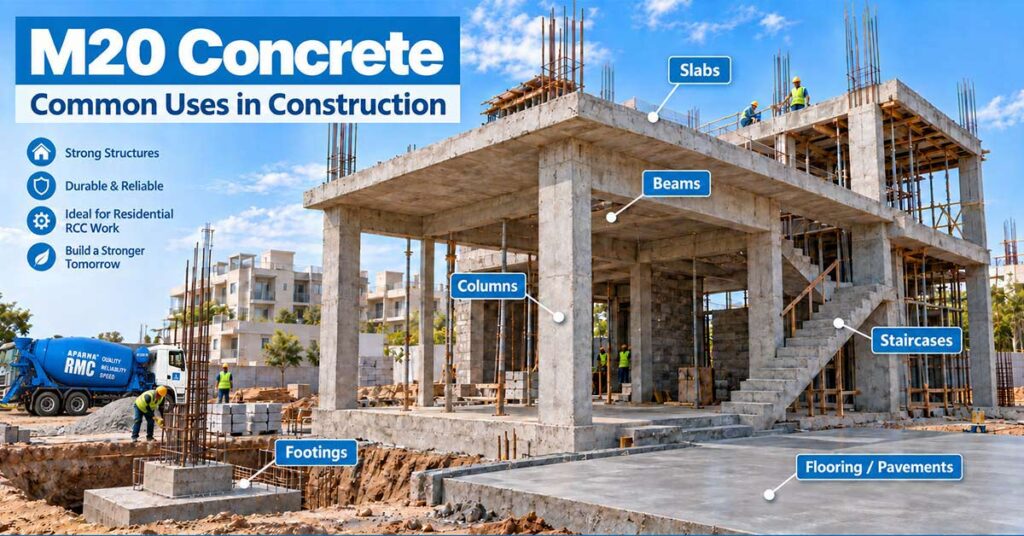
M20 concrete can be used for slabs, beams, columns, footings, foundations, pavements, driveways, and footpaths, if specified in the design. The required grade depends on the load, exposure, and site conditions.
Slabs
M20 can be used for slabs if it is specified in the structural design. The grade depends on the load, span, reinforcement, and exposure.
Beams and Columns
M20 can be used for beams and columns when specified in the design. The number of floors alone does not decide the concrete grade.
Footings and Foundations
The concrete grade for foundations depends on the building load and ground conditions. Soil and groundwater can also affect the requirements.
Pavements, Driveways and Footpaths
M20 can be used for some of these works. The choice also depends on traffic, slab thickness, base support, joints, and curing.
M20 Concrete as per IS 456:2000
The values below apply to normal-weight aggregate with a 20 mm nominal maximum size. IS 456 provides adjustments for other aggregate sizes.
| Exposure | Minimum Grade | Cement | Max. Water-Cement Ratio |
|---|---|---|---|
| Mild | M20 | 300 kg/m3 | 0.55 |
| Moderate | M25 | 300 kg/m3 | 0.50 |
| Severe | M30 | 320 kg/m3 | 0.45 |
| Very severe | M35 | 340 kg/m3 | 0.45 |
| Extreme | M40 | 360 kg/m3 | 0.40 |
These are durability requirements, not exact quantities for making each batch. Check the notes in IS 456 and the relevant amendments before using the values.
The 300 kg/m³ value is the minimum cement-content requirement for reinforced concrete under mild exposure based on IS 456 environmental durability limits. [1]
M20 Concrete Rate and Cost
There is no single M20 concrete rate per cubic metre that applies across India. To get a useful price, the supplier needs the project location, required mix, quantity and delivery details. The services included in the quotation will also affect the amount.
Rate Analysis for M20 Concrete (general)
For an initial estimate of site-mixed concrete, multiply the calculated material quantities by the current rates in your area.
| Cost component | Estimating method for 1 m3 |
|---|---|
| Cement | 8.064 × current price per 50 kg bag |
| Sand | 0.42 × delivered price per m3 |
| Coarse aggregate | 0.84 × delivered price per m3 |
| Water and admixtures | Actual approved quantities and rates |
| Labour | Mixing, handling, placing and compaction |
| Equipment | Mixer, vibrator, power and handling charges |
| Quality control | Required sampling and testing |
| Other costs | Wastage, curing, overheads and applicable taxes |
Check that the units used for quantities and rates match. For example, if sand is sold by the tonne, first convert the required volume to weight using a verified bulk density. Then calculate the cost.
Site-Mixed vs Ready-Mix M20
| Cost factor | Site-mixed concrete | Ready-mix concrete |
|---|---|---|
| Materials | Purchased and stored separately | Included within the supplied mix quotation |
| Production | Site labour and equipment | Plant production |
| Delivery and handling | Separate material movements | Concrete delivery; pumping may be separate |
| Quality control | Site arrangements required | Confirm plant records and site testing responsibilities |
| Wastage and delays | Storage and batching losses | Access, waiting and unused-load considerations |
Compare the total cost of concrete placed at the site for the same requirements. Cheaper materials may not reduce the final cost once labour, handling and delays are included. For ready mix concrete, check which charges have been left out of the quotation.
What Affects the Price?
Before accepting a quotation, check whether it covers GST, transport, pumping, minimum-load charges, waiting time and testing. Confirm the delivery location and how long the quote is valid. Cement and aggregate prices, admixtures, pour timing and the distance from the plant can also affect the rate.
Ordering M20 Ready Mix Concrete
When ordering M20 ready-mix concrete, share the details of your project with the supplier. This helps them plan the right concrete and delivery service.
Before ordering, share these details with the supplier:
- Concrete grade: M20
- Quantity: Required volume in m³
- Slump: Required workability
- Aggregate size: Maximum size required
- Pumping: Whether a concrete pump is needed
- Site details: Location and access conditions
- Pouring plan: Expected pouring rate
Note: When it comes to aggregate size, Aparna RMC offers 20 mm maximum nominal size (MSA), subject to project requirements.
Also confirm the delivery time, unloading arrangements, and required documents before the concrete is dispatched.
For M20 concrete, contact Aparna RMC with your site location, required quantity, and project specifications. The team can confirm availability and provide a quotation.
If you are a homeowner or a builder looking for M20 ready mix concrete for your project, get in touch with Aparna RMC.
Frequently Asked Questions On M20 Concrete
The commonly used ratios are 1:3:6 for M10, 1:2:4 for M15, and 1:1.5:3 for M20. M25, M30, M35, and M40 generally use design mixes, so their ratios can vary.
M stands for mix, while 20 represents the characteristic compressive strength of 20 MPa at 28 days. It does not mean 20 bags of cement or 20% cement.
Using the 1:1.5:3 illustrative calculation, about 403.2 kg of cement is required for 1 m³ of concrete. This is only an example and is not a universal cement requirement for M20. Aparna RMC M20 mixes may use 210 ± 20 kg of OPC and 90–100 kg of fly ash, depending on customer requirements.
M20 does not have a fixed 7-day strength. The strength achieved at 7 days depends on the cement type, mix proportions, curing conditions, and temperature. Seven-day cube results can be used as an early-age strength check, but they should not be treated as a fixed percentage of the 28-day strength.
M20 can be made using either a nominal mix or a design mix, depending on the project requirements. Ready-mix concrete should follow the supplier’s approved mix design.
There is no single water-cement ratio for every M20 mix. For example, at a ratio of 0.50, 50 kg of cement needs 25 litres of water. The actual water requirement also depends on moisture in the aggregates.
M20 does not have one fixed slump value. The required slump depends on how the concrete will be placed, such as pumping, placing, and compaction. Slump shows the workability of fresh concrete, not its final strength.
M20 can be used for pillars and beams if it is specified in the structural design. The required grade depends on the loads, member size, reinforcement, and exposure conditions.
The price depends on the location, quantity, mix, and delivery conditions. Transport, pumping, taxes, waiting time, and testing may also affect the final price. Always check what is included in the quotation.
Note: These quantities are illustrative. Actual M20 mix requirements should follow the approved mix design and project specifications. For exact quantities and mix requirements, contact the Aparna RMC team today!
Categories
Recent Posts
- M20 Concrete Ratio: Mix Proportion, Material Calculation and Uses
- Steel Fiber Reinforced Concrete (SFRC): Types, Properties, Dosage & Applications
- M10 Concrete Ratio: Mix Proportion, Quantities and Uses
- How Ready Mix Concrete Is Made: The RMC Manufacturing Process, Step by Step
- What Is Ready Mix Concrete? A Complete Guide to RMC in Construction
Connect with us