
Fiber Reinforced Concrete (FRC): Types, Properties, Dosage and Applications
September 15, 2026
Fiber-reinforced concrete (FRC) is a type of concrete containing short, discrete fibers uniformly throughout the mix. The fibers are added to the concrete to control cracking and give toughness. Plain concrete cracks under tension, and so when cracks form, it fails. Fibers act as a bridge across the cracks and allow the concrete to continue carrying load after cracking.
This guide covers the different fiber types available, properties FRC actually changes, applications, how FRC compares with conventional steel reinforcement, and how it is specified and tested.
Key Takeaways:
- FRC mixes thousands of tiny, separate fibers evenly through the mix, replacing long bars placed in one flat layer,
- Fibers bridge cracks as they form, giving concrete a post-crack strength that plain concrete lacks.
- Micro fibres help control plastic shrinkage cracking in fresh concrete, and macro fibers provide strength in hardened concrete. They cannot be interchanged.
- Dosages range from under 1 kg/m³ for micro synthetic fibres and up to tens of kg/m³ for steel fibres.
- Fibers can replace wire mesh [for non-structural temperature and shrinkage crack control] in ground slabs, but they can never replace primary steel in beams, columns, or elevated decks.
What Is Fiber Reinforced Concrete?
Fiber-reinforced concrete (FRC) is made by adding short pieces of steel, plastic, glass, or natural fibers directly into the concrete mix to control cracking and add strength after concrete cracks. FRC stands for fiber reinforced concrete, and terms like FRC concrete refer to the same material.
How fibers work in concrete?
Concrete is strong in compression and weak in tension. So if a section cracks, it loses its strength and breaks completely. Conventional rebars sit in one place and only engage once a crack reaches them. The fibers are distributed in three dimensions through the entire cross-section. They bridge micro-cracks when they are formed, holding the cracked concrete tightly together.
That retained capacity after cracking is called post-crack residual strength. Fibers are added to change how concrete behaves after a crack forms, and not to increase its [ultimate flexural tensile] strength.
Micro fibers vs macro fibers
Micro fibers are fine, small, and synthetic fibres that stop plastic shrinkage cracks when concrete is fresh in the first hour after placing. They have no role in hardening the concrete (structural performance of the hardened concrete). Macro fibers are larger and longer, mixed to make hardened concrete tough after it cracks. They can replace wire mesh.
Common misconception: Micro fibers do not add ductility or replace structural reinforcement. They only prevent early cracks in wet concrete; structural, post-crack strength requires macro fibers.
Using fibers like straw in mud brick or horsehair is ancient, but modern engineered steel and synthetic fiber concrete started in the mid-twentieth century.
Types of Fiber Reinforced Concrete
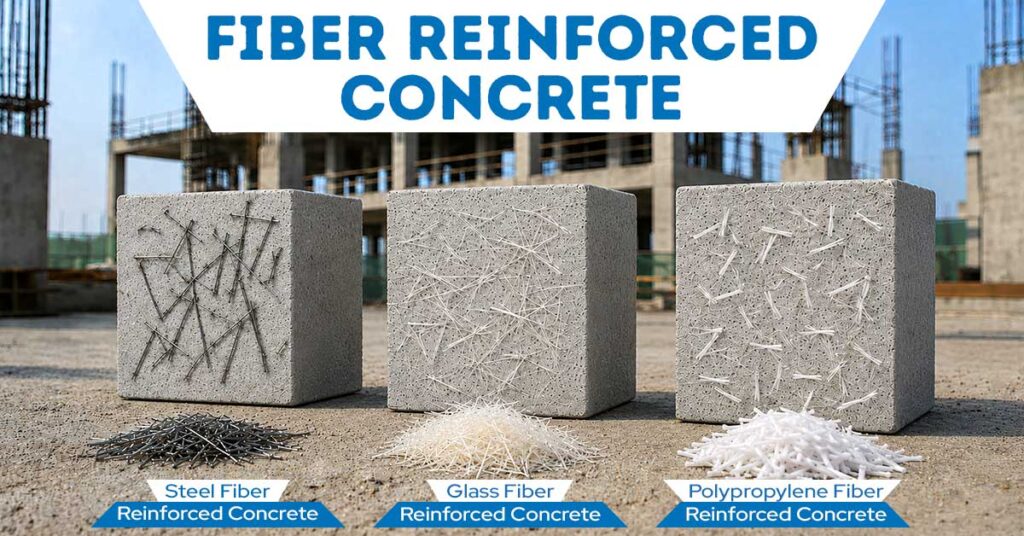
Concrete fibers fall into a few distinct families. When picking one, focus on what you need it to do – prevent early shrinkage, add heavy-duty strength, or shape architectural details. There are different types of concrete fibers like steel fibers, macro synthetic fibers, micro synthetic fibers, glass fibers, natural fibers, and specialty fibers.
- Steel fibers: Steel fibers provide maximum tensile strength and post-crack capacity for heavy-duty applications like industrial floors, tunnel linings, shotcrete, and precast elements. However, they are susceptible to corrosion in harsh environments. So effective crack-width control is necessary to prevent moisture penetration and rusting.
- Macro synthetic fibers: Macro synthetic fibers are made of thick polypropylene or polyolefin, which provides post-crack strength without any risk of rusting. They can replace wire mesh in ground slabs, shotcrete, and precast concrete. They are less stiff than steel, so they must be used in higher dosages.
- Micro synthetic fibers: Micro synthetic fibers are fine polypropylene or similar thin polymer filaments. They offer early-stage protection and are used to control plastic shrinkage cracking during the initial hours of curing. Certain polypropylene microfibres, when specified at suitable dosages, can help reduce the risk of explosive fire spalling in concrete. They do not add any strengthening properties to hardened concrete, and only act as a plastic-shrinkage control measure.
- Alkali-Resistant (AR) Glass Fibers: AR Glass Fibers are used in GFRC/GRC (glass fiber reinforced concrete) for cladding panels, architectural mouldings and landscape elements. They are good for creating thin, lightweight sections with quality surface finishes. They only serve an architectural role and do not provide any structural support.
- Natural fibers: Natural fibers are sourced from coir, sisal, jute, bamboo, and other types of materials. They have been in use for a long time and are still studied because they are low-cost and eco-friendly. The natural fibers do not stop cracks in commercial concrete. They also raise durability concerns in the alkaline cement environment.
- Specialty fibers: Fibers like carbon, basalt, and PVA/PAN provide high strength, but they come at high cost. They are used for specialised engineering projects.
Note: Fiber reinforced polymer (FRP) is different from FRC. FRP is a solid composite material [such as bars or laminates], and not loose fibers mixed into concrete.
Fiber Type Comparison
This table compares different types of fiber reinforced concrete:
Fiber Type | Main Purpose | Where Used | Biggest Downside |
|---|---|---|---|
| Steel | Keeps cracked concrete strong | Factory floors, tunnels, precast | Can rust if cracks are wide |
| Macro Synthetic | Long-term toughness, zero rust | Pavements, slabs, shotcrete | Requires heavy doses to work |
| Micro Synthetic | Stops cracks while concrete dries | Concrete where plastic shrinkage or fire-spalling risk is being addressed | Does not strengthen dry concrete |
| Glass | Holds detailed shapes together | Thin architectural panels, molds | Provides no load-bearing strength |
| Natural | Low-cost eco-friendly testing | Cheap housing, research | Durability concerns in the alkaline environment |
| Specialty | Extreme high performance | Niche engineering projects | Expensive for normal jobs |
Properties of Fiber Reinforced Concrete
Some of the properties of FRC include compressive strength, flexural and post-crack residual strength, toughness and energy absorption, impact and abrasion resistance, crack control, fatigue and durability, workability, and density.
- Compressive strength: Any gains are marginal because fibers are not added for compression. They are primarily used for crack propagation control.
- Flexural and post-crack residual strength: Macro fibers allow the concrete to carry load by acting as tiny internal anchors when cracks occur. On the other hand, plain concrete cannot pull itself back when cracks occur.
- Toughness and energy absorption: Fibers substantially boost toughness and shock absorption, which helps concrete resist sudden cracking and impact damage.
- Impact and abrasion resistance: Protects concrete from heavy drops and surface friction, making it suitable for heavy-traffic factory floors, roads and pavements, roads, and pavements.
- Crack control: Wet concrete uses microfibers to prevent surface cracks as it dries. Hardened concrete uses macro fibers to hold cracks tightly together, helping limit crack widths and reduce pathways for water ingress.
- Fatigue and durability: By holding cracks tightly together under daily traffic, fibers help limit crack widths and reduce the potential for water and chemical ingress into the concrete and destroying it from within. It leads to increased durability.
- Workability: Fibers make wet concrete stiff and hard to pour. This can be fixed with a chemical thinner (plasticiser), and [you should] never add extra water, or you will ruin the strength.
- Density: At typical synthetic fibre dosages, the effect on concrete density is usually negligible. Higher steel fibre dosages can measurably increase density and should be accounted for during mix design.
Factors affecting FRC properties
The performance a given dosage delivers depends on: the fiber type and material; the aspect ratio (fiber length divided by diameter); the dosage itself; how uniformly the fibers are oriented and distributed through the section; and the overall mix design. Aspect ratio matters in a specific, causal way — a higher aspect ratio improves crack bridging but also worsens workability and increases the risk of balling (fibers clumping together instead of dispersing), so it is chosen as a balance, not maximised.
Fiber Dosage: How Much Fiber Goes into Concrete?
Fiber content is specified either as a dosage in kilograms per cubic metre (kg/m³) or as a volume fraction of the mix. The two are not directly interchangeable across fiber types, because fiber densities differ enormously — steel is roughly eight times denser than polypropylene — so a similar volume fraction of two different fiber types produces very different kg/m³ figures. This is the single most common source of confusion in fiber specification, and worth checking explicitly whenever a dosage is being compared across fiber types.
Typical Fiber Dosage by Type
Fiber Type | Typical Dosage Range (kg/m³) | Purpose at That Dosage |
|---|---|---|
| Micro Synthetic | 0.6–1.5 | Plastic shrinkage crack control |
| Macro Synthetic | 3.0–10.0 | Post-crack toughness/mesh replacement |
| Steel | 20.0–80.0 | Structural toughness — industrial floors, shotcrete |
| Glass (AR-Glass) | 10.0–40.0 | GFRC/GRC applications |
How FRC is mixed and batched?
Fibers can be added at the plant or on site, but they must be mixed thoroughly to spread evenly. If you add it too fast, at a dose too high, or not mixed long enough, they will clump together (balling). The clumping can be prevented by adding the correct dosage, adequate mixing time, and slow addition. Mixing at the concrete plant gives a much more even blend than adding them on site.
In general, plant batching gives more consistent dispersion than ad hoc addition on site. This is because, in the plant, fibers are dosed by weight under controlled conditions.
Fiber Reinforced Concrete vs Rebar: Can Fibers Replace Steel?
Fibres can replace wire mesh for secondary crack control in some applications, but they cannot replace primary reinforcement such as steel rebar in beams, columns, or structural slabs. Any such change should be based on a proper structural design.
Rebar and fibres perform different functions. Rebar provides higher tensile strength at specific locations, while fibres are distributed throughout the concrete and help control cracks. For this reason, fibres may replace mesh in suitable cases, but they are not a direct replacement for structural steel.
Fiber Reinforcement vs Conventional Steel Reinforcement
Parameter | Fiber Reinforcement | Steel Rebar / Mesh |
|---|---|---|
| Location | Spread evenly everywhere inside the concrete | Placed in flat rows at exact spots |
| Main Job | Controls cracks and adds toughness | Carries heavy structural pulling loads |
| Site Work | Mixed directly into the wet concrete | Cut, bent, and tied by hand on site |
| Rusting | Synthetics never rust; steel fibers can rust at cracks | Rusts easily if concrete cracks or is too thin |
| Best Uses | Ground slabs, warehouse floors, shotcrete | Beams, columns, and building foundations |
| Where It Fails | Cannot replace primary structural bars | — |
Applications of Fiber Reinforced Concrete
- Industrial and warehouse floors: Mesh replacement, faster placement and better crack control across large, uninterrupted pours.
- Shotcrete for tunnels, mining and slope stabilisation: Fibers can be sprayed with the mix where placing mesh is slow and hazardous.
- Pavements, hardstandings and external slabs: Impact and fatigue resistance under repeated wheel loading.
- Precast elements: Thinner sections, better handling robustness and faster demoulding cycles.
- Architectural cladding and panels (GFRC/GRC): Fibres help create thin, lightweight panels in complex shapes.
- Repair, overlays and jacketing: Improved bond behaviour and crack resistance in thin repair sections.
- Water-retaining and marine structures: Fibres help control cracks and improve durability. Steel fibres need extra care in marine conditions because of corrosion.
- Residential slabs and driveways: Microfibres help control plastic shrinkage cracks.
In each of these, fibers do a specific job defined by the specification — they are not a general-purpose upgrade added to any mix regardless of application.
Advantages of Fiber Reinforced Concrete
- Post-crack toughness: Normal concrete loses much of its load-carrying capacity after cracking. In fibre-reinforced concrete, the fibres help hold the cracked concrete together. This allows the concrete to carry load even after cracks appear and reduces the risk of sudden failure.
- Uniform crack control: Fibres are distributed throughout the concrete mix, so they can help control small cracks in different areas. Rebar provides reinforcement mainly along the locations where the bars are placed. This makes fibres useful for controlling shrinkage and other fine cracks across the concrete surface.
- Faster construction: Steel mesh needs to be cut, placed and fixed before concrete is poured. With fibre-reinforced concrete, the fibres are added directly to the concrete mix. This can reduce the time needed for placing reinforcement and make the concreting process faster.
- Labour savings and safety: Handling steel bars or wire mesh takes more time and labour. When fibres are used instead of mesh in suitable applications, fewer workers may be needed for reinforcement work. This can reduce labour costs and make handling easier at the site.
- Abrasion & fatigue resistance: Dropped tools and heavy trucks chip or wear away normal concrete. But fiber concrete absorbs these hard hits and stops the surface from wearing down.
- Corrosion-free (synthetic fibres): Water and salt rust traditional steel, breaking the concrete from inside. Synthetic plastic fibers do not rust, so they are perfect for coastal areas or harsh environments.
Limitations and Considerations
- Higher material cost: The fiber concrete costs more upfront than standard concrete. But it helps you save money on workers’ time because you don’t have to spend money laying down steel mesh.
- Reduced workability: The fibers make the wet concrete thick, stiff, and hard to pour. You must never add water because water weakens concrete, and instead use plasticisers to maintain workability.
- Balling risk: If you add too many fibers or mix them poorly, they clump into hairy balls, leaving empty air pockets inside the concrete, making it weak.
- Not a structural substitute: Fibres help control crack formation and crack widths, but they do not replace structural reinforcement designed to carry concentrated tensile loads. So for columns, beams, or heavy walls, you need traditional, thick steel bars.
- Corrosion and rough finish: Steel fibers can corrode where cracks are wide or when exposed. Surface fibers may also cause staining on exposed surfaces.
- Mixing quality: Fibers must be spread evenly to work. This is very hard to do by hand on a building site. It is much safer to let a concrete factory mix it using machines.
- Requires test data: Engineers must look at official test data to make sure the mix is strong enough to hold weight even after it starts to crack. So you cannot guess how many fibres to add.
Specifying and Testing FRC
Fiber-reinforced concrete (FRC) needs a performance class based on residual strength after cracking, not just a fiber amount. So a fiber dosage on its own, without a performance class, is not a complete specification.
The test approach: A notched beam is loaded in a three-point bend test [conforming to standards like IRC:SP:46 or ASTM C1609], and the load the beam still carries at defined crack-mouth opening displacements is measured. These residual strength values feed directly into the structural design. Indian FRC practice follows both national and international rules. Request specific test data from your supplier based on your exact project dosage and design needs.
Fiber Reinforced Concrete from Aparna RMC
Aparna RMC delivers high-performance Fiber Reinforced Concrete (FRC) by focusing on uniform fiber mixing for industrial floors, and warehouse, building construction projects, and pavements.
Aparna RMC mixes fibers at the plant by weighing every batch precisely according to the mix design. This plant-controlled process ensures your specified dosage is exactly what is delivered to the site. Do you have any fiber concrete requirements for an upcoming pour? 📞Talk to the Aparna RMC team to know the details of the required type and dosage.
Frequently Asked Questions On Fiber Reinforced Concrete
Fibre-reinforced concrete costs more upfront than normal concrete because fibres are added to the mix. The cost depends on the type and quantity of fibre used. However, FRC can reduce labour requirements and repair costs in some applications, which may help offset the higher initial cost.
FRC does not require a separate curing method from conventional concrete. However, proper curing remains essential for strength and durability. Microfibres can help reduce plastic shrinkage cracking, but they do not eliminate the need for curing.
Fibres are not visible on a properly finished concrete surface. But some fibres may be visible on exposed or ground finishes. They can usually wear off or be removed by light abrasion.
Yes, steel fibers exposed at the surface can rust, but they are cosmetic. Synthetic fibers or a surface treatment are best where staining is unacceptable.
Yes, it can be pumped, but fibers make the mix stiff. So plasticisers must be added to plan [the mix properly] and never add water on site. So always discuss pump requirements with the supplier.
Yes, microfibers can be added to small concrete mixes to help control plastic shrinkage. Use only the recommended dosage given on the product packaging. Macro and steel fibres are different, as they need the right dosage and proper mixing to work effectively. They are better suited for professionally designed concrete applications.
Store fibres in a dry, clean and covered place. Keep them sealed and off the ground to protect them from moisture and dirt. Wet or contaminated fibres can form clumps and affect mixing. It is also better to follow the storage instructions given by the manufacturer.
Fibre-reinforced concrete can be more sustainable in some applications. It can reduce the amount of steel needed in concrete, which can lower the use of materials and energy. However, it depends on the type of fibre, the quantity used and the application.
Categories
Recent Posts
- Fiber Reinforced Concrete (FRC): Types, Properties, Dosage and Applications
- Dry Mix Concrete: Grades, Quantity, Site Use and When to Choose It
- Types of Admixtures in Concrete: Chemical & Mineral Explained
- Water Cement Ratio in Concrete: Formula, Ideal Values & Strength
- What Is Lightweight Concrete? Types, Advantages & Where It’s Used
Connect with us