
Dry Mix Concrete: Grades, Quantity, Site Use and When to Choose It
September 9, 2026
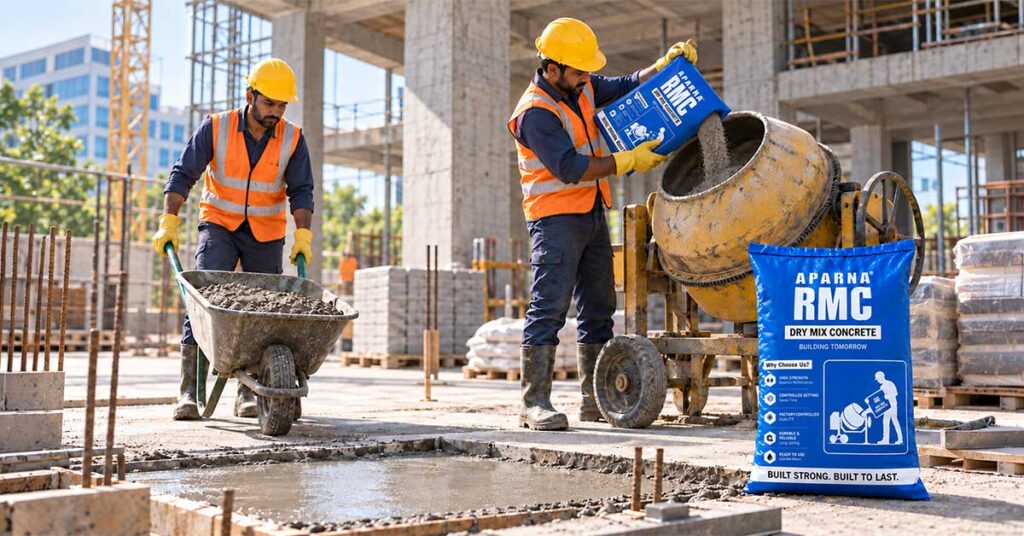
Dry mix concrete is a pre-blend of cement, sand, and graded coarse aggregate, which is offered dry in sealed bags. The hydration process starts only when water is added on site, so the material can be stored and used batch by batch. It is used for small concreting jobs where a full ready-mix delivery is not practical.
- Grade range: M10 to M35
- Bag weight: 40 kgs
- Water per bag: 3.5 -4 litres per bag
- Shelf life from packing: 2 months from the date of packing
What Is Dry Mix Concrete and What Goes Into It?
Dry mix concrete is a pre-proportioned, factory-blended mixture of cement, sand, and graded coarse aggregate. They are supplied dry in sealed bags, and later on, water is added as and when required. This is what separates this from the wet-delivered form of concrete.
The composition is simple, and each component performs a specific job:
- Cement: It acts as the binder, reacting with water to form the hardened matrix that holds the mix together.
- Fine aggregate (sand): This fills the voids between coarse particles and contributes to workability and finish.
- Graded coarse aggregate: It carries the majority of the load once the concrete sets, and its grading controls strength and density.
- Chemical admixtures (where used): They are used to adjust setting time, workability or durability for specific site conditions.
- Weigh-batching measures ingredients by weight instead of volume, which eliminates the inconsistencies of using standard containers on site.
Sand is pre-washed and graded to maintain uniform particle size and minimal silt. This means every scoop in the bag behaves the same way once water is added.
The hydration process is one of the main reasons why dry mix concrete is can be manufactured in one location, stored, transported, and used batch by batch on demand.
Grades Available and What They Correspond To
Concrete Grade | Nominal Cement : Sand : Aggregate Ratio | Best Applied For |
|---|---|---|
| M10 | 1 : 3 : 6 | Pipe bedding, pathways, basic foundations |
| M15 | 1 : 2 : 4 | Small footings, structural starters |
| M20 | 1 : 1.5 : 3 | Concrete stairs, basic structural parts |
| M25 | Use the manufacturer’s approved grade. | Pathway repairs, garden post setting |
| M30 | Use the manufacturer’s approved grade. | Driveway & ramp repairs, pump pads |
| M35 | Use the manufacturer’s approved grade. | Patching small leaks, securing solar panel racks |
Note: Nominal ratios shown here are conventional reference ratios and should not be interpreted as the actual factory batching proportions of PortCrete.
Fixed nominal ratios are only permitted up to grade M20. Mixes above M20 must be custom-designed in a lab per IS 10262.
Dry Mix Concrete, Ready-Mix, Site-Mixed and Dry Mortar — What's Actually Different
Dry-Mix, Ready-Mix, Site-Mixed concrete, and Dry Mortar may sound similar, but they are different products. The table below compares them:
Material | What It Is | Water Added | Where Mixed |
|---|---|---|---|
| Dry Mix Concrete | Factory dry bags with stones | On site | On site |
| Ready-Mix (RMC) | Wet mix from a plant | At plant | At plant / transit |
| Site-Mixed | Raw materials measured by hand | On site | On site |
| Dry Mortar | Factory dry bags with fine sand only | On site | On site |
Dry mortar lacks coarse aggregates, and it is used only for plaster, masonry, and tile-laying purposes. Dry-batched concrete is a plant-batched method for wet read mix concrete. These are not similar to dry mix concrete.
Disclaimer: Even though M25, M30, and M35 are major structural grades, pre-blended dry concrete bags are only intended for minor repairs and small-scale applications. They must not be used for casting major, large-scale structural elements.
Dry Mix Concrete vs Wet Ready-Mix Concrete
The table below compares factory-blended bagged dry mix concrete with wet ready-mix concrete:
Factor | Dry Mix Concrete | Wet Ready-Mix Concrete |
|---|---|---|
| Water Added | On-site | At the factory |
| Minimum Order | Single bag | 10 cubic meters |
| Time Limit | 2 months from the manufacturing date (stored dry) | 90 minutes from the factory |
| Consistency | Varies by on-site mixing | High plant-controlled uniformity |
| Site Equipment | Mixer or manual tools | Placement and finishing tools |
| Testing Logs | None provided | Full batch and cube test data |
| Best Used For | Small patches and repairs | Large slabs and structures |
Strength depends on mix design, water content, compaction, and curing, not the delivery format. The operational differences depend entirely on four factors: volume, placement speed, storage space, and the need for formal quality certificates.
Which One Should You Use for a Small Project?
- Small Volumes: Below minimum ready-mix delivery limits, transit mixers are unavailable or uneconomical. Bagged dry-mix is practical because it has no minimum order quantity.
- Medium Volumes: Up to the bag-handling limit, bagged dry-mix is best. It provides factory quality with no delivery minimums, bought and mixed as needed.
- Large Volumes: Above the bag-handling threshold, wet ready-mix is superior. Manually opening and mixing bags creates a labor bottleneck.
- Quality Control: When documented mix designs, batching records, or cube testing are required, wet ready-mix is mandatory regardless of volume.
- Restricted Access: If a transit mixer cannot reach the site (narrow lanes, upper floors, tight plots), bagged dry-mix is the only workable option.
Volume |
Access |
Documentation |
Recommended Option |
|---|---|---|---|
| Small | Restricted | Not required | Dry mix concrete |
| Small | Open | Required | Wet ready-mix |
| Medium / Large | Open | Either | Wet ready-mix |
| Medium / Large | Restricted | Not required | Dry mix concrete |
What Affects the Quality and Performance of Dry Mix Concrete?
The quality of concrete depends on both factory precision and proper site execution. The factory ensures material accuracy, but the site worker controls the water, mixing, and curing. So too much water on-site destroys the concrete’s strength, irrespective of how perfectly the dry mix is made in the factory.
Controlled by the Manufacturer | Controlled at Site |
|---|---|
| Cement type and grade | Water quantity added |
| Coarse aggregate grading and size | Mixing method and duration |
| Sand fineness and silt content | Batch consistency between bags |
| Weigh-batching accuracy | Placement and compaction |
| Blend uniformity and segregation control | Curing duration and method |
| Packaging moisture barrier | Weather and ambient temperature |
| Packing age and supply-chain storage | On-site storage before use |
Concrete quality relies on two pillars – factory precision and site execution.
- Factory precision: The manufacturer weigh-batches the exact cement grade, graded gravel, and clean sand before sealing the bag. Site workers cannot fix these ingredients if they are incorrect, making factory consistency mandatory.
- Site execution: The site team controls water addition, mixing time, compaction, and curing. Adding too much water to make placement easier permanently destroys concrete strength, and shortchanging the mixing or curing process completely ruins the factory-built quality.
How to Use Dry Mix Concrete on Site?
- Check the bag: Check the packing date, make sure the bag is sealed properly, and look for any hard lumps before opening it.
- Measure the water: Measure the specified quantity of clean water for the selected PortCrete grade. Follow the product-specific water requirement on the packaging or technical data sheet. For Aparna RMC’s dry mix concrete, it is 3.5 to 4 litres per bag.
- Add water to the mix: Add the dry material to the measured water and not the other way around. This helps the mix properly.
- Mix well: Mix until the concrete becomes even and there are no lumps.
- Use it within the working time: Initial setting occurs within 120–180 minutes, and final setting completes within 480–600 minutes under standard temperatures. Place the concrete before it starts to set.
- Compact the concrete: Tap or vibrate the concrete to remove trapped air.
- Finish the surface: Level the concrete while it is still wet. Once the surface water is gone, smooth or brush it as needed.
- Cure the concrete: As per IS 456:2000 (Clause 13.5.1), cure the concrete for at least 7 days for OPC and 10 days for blended cements. In hot and dry weather, longer curing may be needed.
Common Mixing and Curing Mistakes to Avoid
- Do not add extra water.
- Do not add water after the mix starts to stiffen.
- Do not mix part of a bag without reducing the water in the same ratio.
- Do not skip proper compaction.
- Do not skip curing, even for a small batch.
Curing in India’s weather
Rain and heat can affect curing. During the monsoon, protect fresh concrete from rain until it sets. In hot, dry weather, start curing early and keep the concrete wet to stop it from drying too quickly.
How Many Bags of Dry Mix Concrete Do You Need?
Each 40 kg bag provides approximately 0.018 m³ of concrete. At a yield of 0.018 m³ per bag, approximately 56 bags are required to produce 1 m³ of concrete.
The number of bags required depends on the volume of concrete needed. At a yield of approximately 0.018 m³ per 40 kg bag, divide the required concrete volume by 0.018 to estimate the number of bags. Round up to the nearest whole bag and allow for reasonable material wastage.
Always add extra for waste and round up to whole bags, as partial bags are hard to mix with water accurately.
Storing Dry Mix Concrete: Shelf Life, Moisture and Monsoon Conditions
Dry concrete bags last 2 months from packing if kept dry and sealed. Moisture exposure can cause premature hydration, hardening and loss of performance. Keep unopened bags dry and protected from moisture.
Storage Checklist:
- Keep bags off the ground on pallets.
- Keep away from damp walls and keep covered.
- Use older bags first.
Signs it is damaged:
Use older bags first and check each bag before use. Look for hard lumps, changes in weight, or discolouration. If you notice any of these signs, do not use the bag. Indian monsoon humidity and open storage can reduce the usable life of the mix, so treat the stated 2-month shelf life as a best-case period, not a guarantee.
Where Dry Mix Concrete Works — and Where It Doesn't?
Application | Suitable Use |
|---|---|
| Trench filling | Filling and levelling non-structural trenches |
| Pathway repairs | Small-scale pathway and surface repairs |
| Pothole repairs | Small pothole and localised concrete repairs |
| Small pads and bases | Non-structural bases for suitable small installations |
| Garden/post setting | Setting posts and similar small non-structural items |
| Minor repair work | Small repairs where the specified concrete grade is appropriate |
Dry mix concrete is not the right choice for every job. Do not use it for:
- Large Structural Pours: Hand-mixing separate small batches creates weak seams (“cold joints”) and inconsistent strength across the structure.
- Certified Jobs: Any project requiring official lab test records, cube test results, and documented batch records.
- Engineered structural applications: Projects requiring a documented design mix, formal testing or certified batch records should use the specified concrete product and grade.
For any of these, use wet ready-mix concrete (RMC) instead.
Can You Make Your Own Dry Mix Concrete?
Yes, you can make your own cement, sand, and coarse aggregate can be mixed dry at your job site. However, buying a pre-blended factory mix gives you better results because of four main advantages:
- Exact Weight: Factory mixes use precise automated scales instead of manual buckets or gauge boxes.
- Cleaner Sand: Factories use washed, graded sand with very low silt content.
- Better Stone Sizes: Factories ensure stones are perfectly sized and evenly graded.
- Moisture Protection: Factory bags have a moisture barrier that a loose pile on site lacks.
PortCrete Dry Mix Concrete from Aparna RMC
PortCrete is Aparna RMC’s bagged dry mix concrete, built for small pours, repairs and jobs where a full ready-mix delivery isn’t practical.
Specification | Detail |
|---|---|
| Grades available | M10, M15, M20, M25, M30, M35 |
| Bag weight | 40 KG |
| Water per bag | 3.5 to 4.0 liters of clean water per bag |
| Yield per bag | Approximately 0.018 m3 |
| Initial and final setting time | Initial: 120–180 Minutes Final: 480–600 Minutes |
| Shelf life | 2 months from the date of packing |
| Manufacturing standard | IS 18685 – 2024 |
| Cities available | Across all Aparna RMC plants |
Frequently Asked Questions On Dry Mix Concrete
Strength depends on mix design, water content, compaction and curing, not on the delivery format. A correctly mixed and cured product can achieve its specified strength. However, structural applications should use the concrete product and grade specified by the project design.
Load-bearing foundations should be based on the project’s approved design and specified concrete grade. Consult the project engineer or technical team before selecting a concrete product.
Additional water lowers the strength of the hardened concrete, even though it makes the mix easier to place. It cannot be corrected again once the water goes in. So everything must be measured properly before mixing.
Yes, you can mix half a bag of dry mix concrete. But you also need to add only half the water mentioned per bag. It must be mixed thoroughly to avoid uneven hydration across the batch.
Yes, you have to do curing for the bagged dry mix concrete. Curing is a must for any concrete type, and the process is identical to that for any other concrete. Hot, dry weather and monsoon conditions must be taken into consideration while curing.
This depends on grade, curing conditions, and ambient temperature. Ensure the timeframe with the supplier before you walk on it.
Yes, but with precautions. Protect the mixed concrete from rainfall until it reaches initial set. Properly store unopened bags by covering them, and they must not be placed on wet ground to prevent moisture ingress before use.
Avoid using bags with hard lumps because it compromises strength. So do not use concrete bags with hard lumps for any structural work.
Bagged dry mix concrete may cost more per unit than buying individual raw materials because it includes factory proportioning, packaging, and convenience. For small jobs, however, it can reduce material handling, labour, and wastage.
No, do not add extra cement because it unbalances the mix design and it can also affect workability, shrinkage, and durability.
Structural applications should be based on the project’s approved design and specified concrete grade. Do not select a grade solely based on a general application table. For structural columns, foundations, staircases or other load-bearing elements, consult the project engineer or technical team and use the specified concrete product and grade.
Categories
Recent Posts
- M20 Concrete Ratio: Mix Proportion, Material Calculation and Uses
- Steel Fiber Reinforced Concrete (SFRC): Types, Properties, Dosage & Applications
- M10 Concrete Ratio: Mix Proportion, Quantities and Uses
- How Ready Mix Concrete Is Made: The RMC Manufacturing Process, Step by Step
- What Is Ready Mix Concrete? A Complete Guide to RMC in Construction
Connect with us