
Types of Admixtures in Concrete: Chemical & Mineral Explained
September 7, 2026
Admixtures are materials added to concrete, other than cement, water and aggregates, to change how it behaves when fresh or after it hardens. They fall into two families: chemical admixtures, dosed at under 5% by mass of cement, and mineral admixtures, which replace 15–70% of the cement itself. In India, chemical admixtures for concrete are specified under IS 9103:2016.
Types Of Admixtures At A Glance
Family | Type | Primary Function | Typical Dosage |
|---|---|---|---|
| Chemical | Water-reducing (plasticiser) | Cuts water demand 5–12% at the same workability | 0.3–1.5% by mass of cement |
| Chemical | Superplasticiser (high-range water reducer) | Cuts water demand 15–30%; produces flowing concrete | 0.5–2.0% or up to 2.5% |
| Chemical | Retarder | Delays setting; protects long transit and hot-weather pours | 0.05–0.3% |
| Chemical | Accelerator | Speeds up setting and early strength gain | 0.5–2.0% |
| Chemical | Air-entraining | Creates stable microscopic air voids for freeze-thaw resistance | 0.005–0.05% |
| Chemical | Integral waterproofing | Reduces capillary absorption and permeability | 0.5–2.0% |
| Chemical | Corrosion-inhibiting | Protects embedded reinforcement in aggressive exposure | Per manufacturer |
| Chemical | Shrinkage-reducing | Lowers drying shrinkage and cracking risk | 1.0–2.0% |
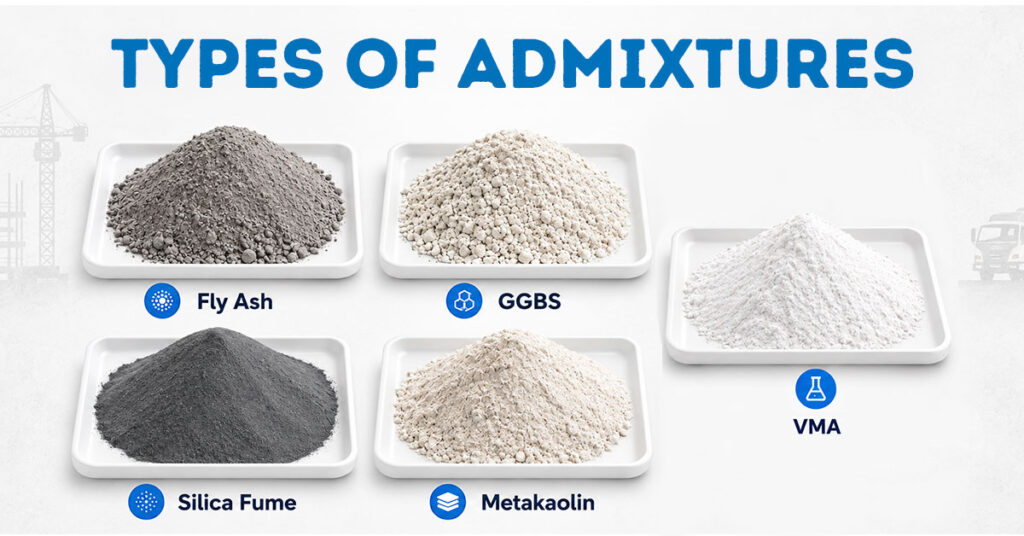
| Chemical | Viscosity-modifying (VMA) | Prevents segregation in high-flow mixes | 0.05–0.5% |
| Mineral | Fly ash | Reduces heat of hydration; improves long-term durability | 15–35% cement replacement |
| Mineral | GGBS | Improves sulphate and chloride resistance | 25–70% cement replacement |
| Mineral | Silica fume | Produces very high strength and very low permeability | 5–10% cement replacement |
| Mineral | Metakaolin | High early pozzolanic reactivity, light colour | 5–15% cement replacement |
What Is an Admixture in Concrete?
An admixture is any material other than cement, aggregates, water and reinforcement that is added to a concrete mix immediately before or during mixing, in order to modify one or more of its properties. IS 456:2000 permits their use provided they conform to the relevant Indian Standard and do not impair the durability of the concrete.
The properties admixtures are used to control are specific and measurable: workability and slump retention, setting time, rate of early strength gain, permeability, heat of hydration, shrinkage, and resistance to chemical attack.
Admixture vs Additive: The Distinction That Matters
The two words are used interchangeably online, but they are not the same thing in practice. An admixture is introduced at the concrete mixing stage. An additive is interground or blended at the cement manufacturing stage, before the cement ever reaches a batching plant.
The distinction matters commercially. When fly ash is interground at a cement plant, the result is Portland Pozzolana Cement — the fly ash is an additive and the proportions are fixed. When the same fly ash is dosed at a ready mix concrete plant, it is a mineral admixture and the proportion can be adjusted for each individual mix design.
How Much Admixture Actually Goes into Concrete?
This is where most explanations of admixture types become misleading, because the two families operate at completely different scales.
Chemical admixtures are dosed at under 5% by mass of cement, and most are used at well under 1%. A superplasticiser at 1% in a mix containing 350 kg of cement means 3.5 kg — roughly three and a half litres in a full cubic metre of concrete. At that scale, a dosing error of a few hundred millilitres is a significant proportional error.
Mineral admixtures are dosed at 15% to 70% by mass of cement, because they are not modifiers — they replace part of the cement. They are more accurately described as supplementary cementitious materials.
Any article that presents these two families as parallel items in one list is hiding a difference of two orders of magnitude.
How Admixtures Are Classified?
There are three classification systems in common use, and they answer different questions. Understanding which one a specification is referring to prevents a great deal of confusion on site.
Classification by Material: Chemical and Mineral
This is the broadest split and the one most commonly used in Indian practice.
Chemical admixtures are organic or inorganic compounds, usually supplied as liquids, that modify fresh or hardened concrete properties at very low dosages. They do not contribute to the binder.
Mineral admixtures are finely divided solid materials — mostly industrial by-products — that participate in the hydration reaction and form part of the binder system. They are also called supplementary cementitious materials, or SCMs.
IS 9103:2016 — The Indian Classification
Concrete Admixtures — Specification, is the governing Indian Standard for chemical admixtures. It sets out requirements for accelerating, retarding, water-reducing, air-entraining and superplasticising admixtures, along with the uniformity and performance tests each must satisfy.
Two practical consequences follow from this. First, when a specification says “admixture conforming to IS 9103”, it is a chemical admixture that is being referred to — mineral admixtures are covered by their own separate standards. Second, an admixture that does not conform to IS 9103 has no place in structural concrete, regardless of what the supplier’s literature claims.
ASTM C494 — The Type A to Type G Classification
International specifications, and most multinational admixture manufacturers, use the ASTM C494 standard classification. It is worth knowing because it appears on product data sheets sold in India.
| ASTM C494 Type | What It Does | Indian Equivalent Term |
|---|---|---|
| Type A | Water-reducing | Plasticiser |
| Type B | Retarding | Retarder |
| Type C | Accelerating | Accelerator |
| Type D | Water-reducing and retarding | Retarding plasticiser |
| Type E | Water-reducing and accelerating | Accelerating plasticiser |
| Type F | Water-reducing, high range | Superplasticiser |
| Type G | Water-reducing, high range, and retarding | Retarding superplasticiser |
| Type S | Specific performance | Speciality admixture |
Types D, E and G are the ones that matter most in Indian ready mix concrete. A single product that both reduces water and retards setting solves the two problems a concrete truck faces simultaneously — it has to stay workable through transit and still reach design strength.
Types of Chemical Admixtures in Concrete
Water-Reducing Admixtures (Plasticisers)
Plasticisers reduce the water needed to achieve a given workability by approximately 5–12%. They work by dispersing cement particles that would otherwise clump together, releasing the water trapped between them.
That water reduction can be taken in one of three ways, and the choice is a mix design decision, not a site decision:
- Keep the water and cement the same, and gain workability
- Reduce the water at the same cement content, and gain strength
- Reduce both water and cement proportionally, and reduce cost at the same strength
Common base chemistries are lignosulphonates and hydroxycarboxylic acids. Typical dosage is 0.3–1.5% by mass of cement.
Superplasticisers (High-Range Water Reducers)
Superplasticisers achieve water reduction of 15–30% — two to three times what a conventional plasticiser can deliver. They are the reason modern high-grade concrete exists at all. Producing M60 or M80 concrete with a water-cement ratio around 0.30 is not possible without them.
Modern superplasticisers are almost entirely polycarboxylate ether based, usually written as PCE. Earlier generations — sulphonated naphthalene formaldehyde (SNF) and sulphonated melamine formaldehyde (SMF) — are still available and cheaper, but lose slump considerably faster.
That slump retention difference is the whole argument in ready mix concrete. A naphthalene-based superplasticiser may hold workability for 30 to 45 minutes; a PCE designed for slump retention can hold it for 90 minutes or more. In city traffic, that is the difference between concrete that can be placed and concrete that is rejected at the gate.
Retarding Admixtures
Retarders delay the initial setting of concrete. They are essential in three situations: hot weather concreting, long transit distances, and large continuous pours where a cold joint must be avoided between successive layers.
In Hyderabad and across Telangana, summer ambient temperatures make retardation a routine requirement rather than a special measure. Cement hydration accelerates sharply with temperature, and concrete that would remain workable for two hours in January can stiffen in under an hour in May.
Common retarders include sugars, hydroxycarboxylic acids and their salts, and lignosulphonates. Typical dosage is 0.05–0.3% by mass of cement.
One caution that matters more than the dosage figure: retarder overdosing does not simply delay setting by a proportionate amount. Beyond a threshold, it can prevent the concrete from setting properly at all, and there is no remedy for that once it has been placed.
Accelerating Admixtures
Accelerators speed up setting, early strength gain, or both. They are used for early formwork removal, emergency repairs, shotcrete, and cold-weather concreting.
Calcium chloride is the classical accelerator and it must not be used in reinforced concrete. Chlorides promote corrosion of embedded steel. IS 456:2000 places limits on the total chloride content of concrete, and any chloride contributed by an admixture counts towards that limit.
The practical rule is straightforward: for any concrete containing steel, use a chloride-free accelerator, and ask the supplier for the chloride content in writing.
Air-Entraining Admixtures
Air-entraining admixtures deliberately introduce stable microscopic air bubbles — typically 4–7% of the concrete volume — distributed evenly through the paste. Those voids give freezing water somewhere to expand into, which is what protects concrete from freeze-thaw damage.
In most of India this is not a relevant durability requirement. Freeze-thaw cycling is a genuine concern only in high-altitude and Himalayan projects. Most global writing on admixtures is North American or European in origin, which is why air entrainment is given far more prominence in online articles than Indian conditions justify.
Where air entrainment is used in Indian practice, it is usually for a secondary benefit — improved cohesion and reduced bleeding in harsh or gap-graded mixes. It carries a real cost: roughly 5% strength loss for each 1% of entrained air, so it should never be specified without a reason.
Integral Waterproofing and Damp-Proofing Admixtures
These reduce the capillary absorption and permeability of hardened concrete. They work either by blocking pores with fine particles or by lining them with water-repellent compounds. Common constituents include stearates, silicates and fine pore-blocking fillers.
The honest limitation is worth stating clearly. An integral waterproofing admixture reduces permeability through sound, well-compacted concrete. It does nothing about a honeycomb, a badly formed construction joint, or a crack. Most water ingress in Indian buildings comes through those three defects, not through the body of the concrete. The admixture is one layer of a waterproofing strategy, not a substitute for one.
Corrosion-Inhibiting Admixtures
Corrosion inhibitors protect reinforcement in chloride-rich environments — coastal structures, marine works, and buildings exposed to de-icing salts or industrial chemicals. Calcium nitrite is the most widely used, working by stabilising the passive oxide film on the steel surface.
They are most effective when combined with a low-permeability mix. A corrosion inhibitor in porous concrete addresses the symptom rather than the mechanism; the durable answer is dense concrete first, inhibitor second.
Shrinkage-Reducing Admixtures
Shrinkage-reducing admixtures lower the surface tension of the pore water inside hardening concrete, which reduces the internal stresses that cause drying shrinkage cracking. Typical dosage is 1.0–2.0% by mass of cement — high by chemical admixture standards, which is reflected in the cost.
They are specified where cracking would be functionally unacceptable: water-retaining structures, large industrial floors, and podium or terrace slabs where restrained shrinkage cracking would compromise waterproofing.
Viscosity-Modifying Admixtures (VMA)
VMAs increase the cohesion of the paste so that a highly fluid mix does not segregate. They are what makes self-compacting concrete possible — SCC has to flow into place under its own weight without vibration, and without the aggregate settling out of the paste as it goes.
They are also used in underwater concreting and in mixes made with poorly graded sand, where the fines content is insufficiet to hold the mix together.
Bonding Admixtures
Bonding admixtures improve adhesion between hardened concrete and a fresh layer placed on top of it. They are polymer emulsions — styrene-butadiene rubber (SBR), polyvinyl acetate (PVA) and acrylic polymers are the common types.
A correction worth noting: several widely circulated articles list polyvinyl chloride (PVC) as a bonding admixture. This is incorrect. PVC is a rigid thermoplastic and is not used as a concrete bonding agent. The polymer intended is polyvinyl acetate.
A second practical point: PVA-based bonding agents re-emulsify in water and should not be used in permanently wet or externally exposed locations. SBR and acrylics are the appropriate choice there.
Anti-Washout Admixtures
Anti-washout admixtures are used for concrete placed underwater — bridge foundations, marine works, and pile caps below the water table. They dramatically increase cohesion so that cement paste is not washed out of the mix as it falls through water. Cellulose-based and welan gum thickeners are typical.
Gas-Forming and Air-Detraining Admixtures
Gas-forming admixtures — usually aluminium powder — release small quantities of hydrogen gas during hydration, causing slight expansion that compensates for settlement. They are used in grouts, particularly for filling under base plates and in post-tensioning ducts, where a shrinkage gap would defeat the purpose of the grout.
Air-detraining admixtures do the opposite of air entrainers: they remove unwanted air introduced by another admixture or by a particular aggregate. Tributyl phosphate and certain water-insoluble alcohols are used. This is a corrective admixture, used in response to a specific problem identified in trial mixes.
Colouring Admixtures (Pigments)
Colouring admixtures are finely ground pigments, usually iron oxides, added to produce coloured concrete for architectural applications — decorative flooring, paving, landscape features and stamped concrete.
Two practical points govern the outcome. Pigment loading is typically 2–8% by mass of cement, and beyond about 10% the strength penalty becomes significant. More importantly, colour consistency depends on absolute batch-to-batch consistency in cement source, water content and curing — which is why coloured concrete is far more reliable when plant-batched than site-mixed.
Chemical Admixtures Compared
Admixture Type | What It Changes | Typical Dosage | Common Base Chemistry | Main Watch-Out |
|---|---|---|---|---|
| Plasticiser | Water demand ↓ 5–12% | 0.3–1.5% | Lignosulphonate | Modest slump retention |
| Superplasticiser | Water demand ↓ 15–30% | 0.5–2.0% | Polycarboxylate ether | Cement compatibility varies |
| Retarder | Setting time ↑ | 0.05–0.3% | Sugars, hydroxycarboxylic acids | Overdose can prevent setting |
| Accelerator | Early strength ↑ | 0.5–2.0% | Calcium nitrate, formates | Never use chloride-based in RCC |
| Air-entrainer | Freeze-thaw resistance ↑ | 0.005–0.05% | Vinsol resin, synthetic surfactants | ~5% strength loss per 1% air |
| Integral Waterproofer | Permeability ↓ | 0.5–2.0% | Stearates, silicates | Does not fix cracks or honeycombs |
| Corrosion Inhibitor | Steel protection ↑ | Per manufacturer | Calcium nitrite | Needs a dense mix to work |
| Shrinkage Reducer | Drying shrinkage ↓ | 1.0–2.0% | Glycol ethers | High cost per cubic metre |
| VMA | Segregation resistance ↑ | 0.05–0.5% | Welan gum, cellulose ethers | Can reduce flow if overdosed |
| Bonding Agent | Old-to-new adhesion ↑ | Per manufacturer | SBR, PVA, acrylic | PVA re-emulsifies when wet |
Types of Mineral Admixtures (Supplementary Cementitious Materials)
Mineral admixtures replace part of the cement rather than modifying the mix. Every one of the materials below is an industrial or agricultural by-product, which is why they sit at the centre of low-carbon concrete practice.
Fly Ash
Typical replacement is 15–35% of the cement, What it delivers:
- Lower heat of hydration — the single most important property for mass pours such as raft foundations and transfer slabs, where internal heat build-up causes thermal cracking
- Improved workability — the spherical particle shape acts as a lubricant in the mix
- Reduced long-term permeability — the pozzolanic reaction refines the pore structure over months
The trade-off is slower early strength gain, because the pozzolanic reaction is slower than cement hydration. Fly ash concrete continues to gain strength well past 28 days, which is an advantage in service but requires the specification and formwork schedule to account for it. Fly ash for use in concrete is covered IS 3812 (Part 1):2023.
Ground Granulated Blast-Furnace Slag (GGBS)
GGBS is produced by rapidly quenching molten slag from iron manufacture and grinding it to a fine powder. Unlike fly ash, GGBS is latently hydraulic — it has cementing properties of its own, activated by the alkaline environment inside concrete.
Replacement levels are much higher: 25–70%, and levels above 50% are used routinely in marine and sulphate-exposed structures.
GGBS is the strongest option available for sulphate resistance and chloride ingress resistance, which makes it the standard choice for coastal construction, sewage-exposed structures, and foundations in aggressive soils. Like fly ash, it lowers the heat of hydration and slows early strength gain.
Silica Fume
Silica fume is an ultrafine by-product of silicon and ferrosilicon alloy manufacture, with particles roughly a hundred times smaller than cement grains. It is used at only 5–10% replacement because it is extremely reactive and physically fills the voids between cement particles.
It is the route to very high strength and very low permeability — high-grade structural concrete, industrial floors subject to abrasion and chemical attack, and marine structures where chloride penetration must be minimised.
It comes with real handling demands. Silica fume concrete is sticky, needs a superplasticiser as a matter of course, and is very sensitive to plastic shrinkage cracking because it bleeds almost none. Curing must begin immediately.
Metakaolin
Metakaolin is made by calcining purified kaolin clay. Unlike the other mineral admixtures, it is a manufactured product rather than a by-product, which makes it more expensive and more consistent.
At 5–15% replacement it delivers performance broadly comparable to silica fume, with two differences that matter architecturally: it is off-white rather than grey, so it does not darken the concrete, and it is easier to handle. It is used in white and coloured architectural concrete where silica fume would ruin the appearance.
Rice Husk Ash
Rice husk ash is produced by controlled burning of rice husks. When the burn is properly controlled, it is highly pozzolanic with a very high amorphous silica content.
Its use in India is limited by consistency rather than by performance. Uncontrolled burning crystallises the silica and destroys the reactivity, so the quality of commercially available material varies widely. It is used in specialised and research applications rather than routine structural concrete.
Mineral Admixtures Compared
Material | Source | Typical Replacement | Principal Benefit | Early Strength Effect |
|---|---|---|---|---|
| Fly ash | Coal-fired power stations | 15–35% | Low heat of hydration; workability | Slower |
| GGBS | Iron manufacture | 25–70% | Sulphate and chloride resistance | Slower |
| Silica fume | Silicon alloy manufacture | 5–10% | Very high strength; very low permeability | Faster |
| Metakaolin | Calcined kaolin clay | 5–15% | Silica-fume-like performance, light colour | Faster |
| Rice husk ash | Burnt rice husks | 10–20% | High pozzolanic reactivity | Variable |
Cementitious vs Pozzolanic: What the Difference Actually Means?
Mineral admixtures are often split into “cementitious” and “pozzolanic” categories without explaining the consequence.
A pozzolanic material — fly ash, silica fume, metakaolin, rice husk ash — has no binding value by itself. It needs the calcium hydroxide produced by cement hydration to react with. That means there is a ceiling on how much cement it can replace: use too much, and there is not enough calcium hydroxide to activate it all.
A latently hydraulic material — GGBS — has binding capability of its own once activated. That is precisely why GGBS can replace up to 70% of the cement while fly ash typically cannot exceed about 35%.
Which Admixture Solves Which Problem?
Site Problem | Admixture to Consider | Why It Works |
|---|---|---|
| Concrete stiffening before it reaches the pour | Retarding superplasticiser (ASTM Type G) | Delays setting while holding slump through transit |
| Congested reinforcement, vibrator cannot reach | Superplasticiser + VMA | Produces flowing concrete that will not segregate |
| Large raft or transfer slab, thermal cracking risk | Fly ash or GGBS | Lowers peak hydration temperature |
| Coastal or marine structure | GGBS or silica fume + corrosion inhibitor | Reduces chloride ingress and protects steel |
| Formwork needed back in 24 hours | Chloride-free accelerator | Faster early strength gain without corrosion risk |
| Basement or water tank leakage risk | Integral waterproofer + low w/c mix | Reduces capillary permeability |
| Large industrial floor, crack control critical | Shrinkage-reducing admixture | Lowers drying shrinkage stresses |
| Underwater foundation pour | Anti-washout admixture | Prevents cement washout during placement |
| Architectural or decorative finish | Pigments + metakaolin | Colour without the darkening silica fume causes |
| May–June pour in Hyderabad | Retarder + temperature-controlled concrete | Counters accelerated hydration in high ambient heat |
Admixture Dosage: How Much Is Actually Added
Dosage is always expressed as a percentage by mass of cementitious material, not by volume of concrete and not by mass of the whole mix. Getting this reference wrong is one of the more common site errors.
Worked Example: Dosage for 1 m³ of M30 Concrete
Take a mix with a total cementitious content of 380 kg/m³ — say 300 kg of OPC plus 80 kg of fly ash.
- Superplasticiser at 0.8%: 380 × 0.008 = 3.04 kg per m³
- At a product density of about 1.1 kg/litre, that is roughly 2.8 litres per cubic metre
- For a 6 m³ transit mixer load: approximately 17 litres per load
Two things follow from those numbers. The dosage is calculated on the total cementitious content including the fly ash, not on the OPC alone — using 300 kg instead of 380 kg would under-dose by 21%. And at under three litres per cubic metre, a measuring error of half a litre is a 17% dosage error. This is exactly why plant dosing is done through calibrated metering equipment rather than by hand.
Why Overdosing Is Worse than Underdosing?
Underdosing produces concrete that is stiffer than intended. It is visible immediately, and it can be corrected in the next batch.
Overdosing produces failures that appear hours or days later, when nothing can be done:
- Superplasticiser overdose causes severe bleeding and segregation — the aggregate settles and the paste rises
- Retarder overdose can delay setting for days, or prevent proper setting altogether
- Air-entrainer overdose costs roughly 5% of compressive strength for every extra 1% of air
- Accelerator overdose causes flash setting in the mixer
Admixtures have a saturation dosage — a point beyond which more product delivers no additional benefit and begins to cause harm. That point is specific to the cement and admixture combination in use, which is why it can only be established by trial mix.
Admixture Compatibility: The Failure Nobody Warns You About
The single most common admixture problem in practice is not choosing the wrong type. It is a compatibility failure between a perfectly good admixture and a perfectly good cement.
Superplasticiser performance depends on the interation between the polymer and the cement’s chemistry — particularly its C₃A content, its alkali content and the form of sulphate present. The same PCE superplasticiser at the same dosage can hold slump for 90 minutes with one cement and 30 minutes with another.
The symptoms of incompatibility are recognisable:
- Rapid slump loss despite correct dosage
- Excessive bleeding or segregation at normal dosage
- Erratic setting times between batches of nominally identical concrete
- Air content varying batch to batch without any change in the mix
The cause is almost always a change in cement source, cement batch, or ambient temperature — not the admixture itself.
Why Trial Mixes are Not Optional?
Compatibility cannot be established from data sheets. It has to be measured with the actual cement, the actual aggregates and the actual admixture, at the temperature the concrete will be produced in.
Pre-pour admixture checklist:
- Admixture conforms to IS 9103:2016 and the test certificate is on file
- Chloride content confirmed in writing, especially for any accelerator
- Compatibility trial run with the current cement source and batch
- Saturation dosage established, not assumed from the data sheet
- Slump retention verified for the actual transit time to site
- Dosing equipment calibrated and calibration recorded
- Dosage calculated on total cementitious content, including any SCM
- Trial repeated if the cement source changes
- Ambient temperature at time of pour accounted for in the dosage
Storage conditions checked — most admixtures have a shelf life and can freeze or separate
What IS 456:2000 Says About Using Admixtures?
IS 456:2000 addresses admixtures directly, and the requirements are short enough to summarise:
- Admixtures may be used, but must not impair the durability of the concrete or attack the reinforcement, per Clause 5.5.
- Any admixture used must conform to the relevant Indian Standard, which for chemical admixtures is IS 9103:2016.
- The chloride contributed by an admixture counts towards the total permitted chloride content of the concrete —under Clause 8.2.5.2 and Table 7.
- The supplier must state the chloride content of the product
The practical implication for anyone specifying concrete is that “we added an admixture” is not a defensible position on its own. What is defensible is a named product, conforming to IS 9103:2016, with a stated chloride content and a trial mix result behind the dosage.
Admixtures in Ready Mix Concrete: How They Are Actually Dosed
Everything above applies to any concrete. What changes in ready mix concrete is the level of control that is achievable — and the level that is necessary.
Why RMC Dosing Differs From Site Mixing?
Site-mixed concrete is placed within minutes of mixing. Ready mix concrete has to survive batching, loading, road transit, queueing at site, and discharge — commonly 60 to 120 minutes between water contact and final placement — and still meet its slump and strength specification on arrival.
That is an admixture problem before it is anything else. Three things have to be true at once: the concrete must remain workable throughout transit, it must not segregate while being agitated in a drum, and it must still reach design strength.
The corresponding practical differences:
- Dosing is metered, not measured by hand. Plant systems dose to a fraction of a litre against a stored mix design.
- Water is corrected for aggregate moisture in real time, so the water-cement ratio the admixture was designed around is the one actually delivered.
- Dosage is adjusted for ambient temperature, which changes several times over a summer working day.
- Every batch is recorded, so a dosage can be traced back after the fact if concrete underperforms.
Slump Retention Over Transit Time
Slump retention is the single most important admixture property in ready mix concrete, and it is the one least discussed in general articles on admixture types.
The failure mode is well known on any site: concrete arrives stiff, and water is added at the gate to make it placeable. That single act can convert an M30 mix into something closer to M20, and it invalidates the cube results entirely — the cubes were cast from concrete that no longer matches what went into the structure.
The correct response is not water at the gate. It is a retarding superplasticiser selected and dosed for the actual transit time, verified by a slump retention trial before the pour, not after.
Admixtures Behind Specialised Concrete
Most specialised concretes are not different materials. They are ordinary concrete plus a specific admixture strategy:
- Self-compacting concrete — high-range PCE superplasticiser plus a viscosity-modifying admixture, so it flows into congested formwork without vibration
- Temperature-controlled concrete — retarders plus mineral admixtures to lower peak hydration temperature, alongside chilled water or ice
- Green concrete — high-volume fly ash or GGBS replacement, cutting embodied carbon
- High-grade concrete (M60 and above) — silica fume plus PCE superplasticiser at very low water-cement ratios
- Coloured and stamped concrete — pigment dosing with tightly controlled batch consistency
How Aparna RMC Handles Admixture Dosing?
Aparna RMC dispenses admixtures through computer-controlled batching systems that dose against a stored mix design for every batch, with water corrected for measured aggregate moisture. Admixture and cement compatibility is established by trial mix before a mix design is released for supply, and dosage is adjusted for ambient temperature during summer production.
The specialised mixes in the Aparna RMC range are built on the admixture combinations described above — self-compacting concrete, temperature-controlled concrete for summer pours, green concrete using fly ash and GGBS, and high-grade concrete for structural applications.
Planning a pour with a specific requirement — long transit, congested reinforcement, a large raft, or a coastal site? Share the mix specification and site conditions with the Aparna RMC technical team and they will confirm the appropriate mix design and admixture strategy.
Common Mistakes with Concrete Admixtures
- Adding water on site after an admixture has been dosed. This defeats the entire purpose of a water reducer and voids the mix design. It is the most damaging and most common of all admixture errors.
- Assuming an admixture will perform the same across different cements. Compatibility is specific to the cement in use. A change of cement source requires a fresh trial.
- Using a chloride-bearing accelerator in reinforced concrete. This introduces a corrosion risk that will not appear for years, and cannot be reversed when it does.
- Calculating dosage on OPC content instead of total cementitious content. In a mix with 25% fly ash, this under-doses by about 25%.
- Treating an integral waterproofer as a waterproofing system. It reduces permeability through sound concrete. It does nothing about cracks, cold joints or honeycombing.
- Specifying air entrainment where there is no freeze-thaw exposure. In most of India this buys nothing and costs measurable compressive strength.
- Ignoring shelf life and storage. Many admixtures separate, settle or degrade over time, and some are damaged by extremes of temperature. A drum that has been standing through a summer may not perform as labelled.
- Combining admixtures from different manufacturers without testing. Two products that each work well can interact badly. Where more than one admixture is used, they should be trialled together and, wherever possible, sourced from a single manufacturer.
Frequently Asked Questions
No. An admixture is added during concrete mixing; an additive is interground during cement manufacture. Fly ash blended at a cement plant produces Portland Pozzolana Cement — that is an additive. The same fly ash dosed at a concrete plant is a mineral admixture, and its proportion can be varied per mix.
IS 9103:2016 covers concrete Admixtures — specification, is the governing Indian Standard for chemical admixtures. IS 456:2000 sets the conditions under which admixtures may be used in structural concrete. Mineral admixtures are covered by separate standards for each material.
Yes, and combinations are routine — a retarding superplasticiser with a VMA, for example. The requirement is that they are trialled together before use. Two individually sound products can interact badly, so wherever possible they should come from the same manufacturer, whose products are formulated to be compatible.
Most do not; several increase it, because reducing water at constant cement content raises strength. The exception is air entrainment, which costs roughly 5% of compressive strength for each 1% of entrained air. Strength loss from admixtures is almost always a dosing or compatibility failure rather than a property of the admixture.
As a percentage by mass of total cementitious content — cement plus any fly ash, GGBS or silica fume in the mix. For a mix with 380 kg/m³ of cementitious material, a 0.8% dose is 3.04 kg per cubic metre. Calculating on cement alone, ignoring the SCM, is a common and significant error.
The effect depends on the type, and none of them are recoverable once placed. Excess superplasticiser causes severe bleeding and segregation. Excess retarder can prevent the concrete from setting. Excess accelerator can cause flash setting in the mixer. Every admixture has a saturation dosage beyond which more product does harm rather than good.
Yes. Most have a stated shelf life, typically 6 to 12 months, and many separate or settle on standing and need re-agitation before use. Extremes of temperature can permanently damage some products. Storage conditions and stock rotation matter as much as selecting the correct product.
Yes, though usually without the homeowner knowing. Any ready mix concrete delivered for a house slab contains at least a water-reducing admixture, and normally a retarder as well. In site-mixed concrete, admixtures are less common because there is no reliable way to dose accurately at that scale.
Integral waterproofing admixtures based on stearates or silicates reduce capillary absorption through the body of the concrete. They are one component of waterproofing, not the whole of it — most leaks travel through cracks, cold joints and honeycombs, which no admixture can address.
Both descriptions are correct. They are classified as mineral admixtures, and functionally they replace part of the cement, which is why they are also called supplementary cementitious materials. This is what distinguishes them from chemical admixtures: they participate in the binder rather than modifying the mix around it.
A retarding admixture, or a retarding superplasticiser where workability also has to be maintained. Retardation counters the accelerated hydration caused by high ambient temperature. For large pours in peak summer, mineral admixtures such as fly ash or GGBS are usually added as well, to lower the peak temperature the concrete reaches internally.
No. Admixtures modify sound concrete; they do not compensate for poorly graded aggregates, an incorrect water-cement ratio, inadequate compaction or insufficient curing. An admixture added to correct a mix problem usually creates a second problem alongside the first.
Categories
Recent Posts
- M20 Concrete Ratio: Mix Proportion, Material Calculation and Uses
- Steel Fiber Reinforced Concrete (SFRC): Types, Properties, Dosage & Applications
- M10 Concrete Ratio: Mix Proportion, Quantities and Uses
- How Ready Mix Concrete Is Made: The RMC Manufacturing Process, Step by Step
- What Is Ready Mix Concrete? A Complete Guide to RMC in Construction
Connect with us