
Water Cement Ratio in Concrete: Formula, Ideal Values & Strength
September 2, 2026
The water cement ratio (w/c ratio) is the weight of water divided by the weight of cement in a concrete mix. For most structural concrete, practical water-cement ratios generally fall between 0.40 and 0.55, although lean mixes and special applications may use different values. It is one of the most critical factors in determining concrete’s strength, durability, and workability.
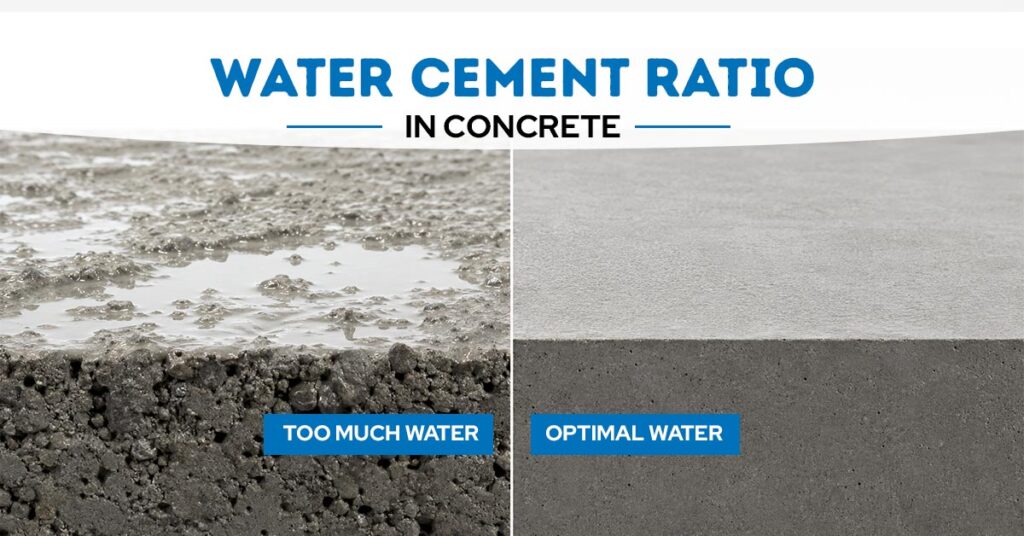
For many structural concrete applications, a water-cement ratio between 0.45 and 0.50 provides a practical balance of strength, durability, and workability. High-strength or high-performance concrete typically uses lower water-cement ratios, often between 0.25 and 0.35, along with suitable chemical admixtures. Adding more water makes the concrete easy to pour but leaves microscopic holes when it dries, making the final structure weak and brittle.
Water isn’t just a mixing convenience – it triggers hydration, the chemical reaction between water and cement that hardens the paste and binds the aggregates together. The water-cement ratio exists to balance two competing needs: enough water for complete hydration and workable placement, but not so much that it weakens the finished concrete. It’s expressed as a decimal — a ratio of 0.50 means 50 litres of water for every 100 kg of cement. A lower w/c ratio gives stronger, denser concrete but is harder to place; a higher w/c ratio is easier to pour but produces weaker, more porous concrete.
Water Cement Ratio Formula & How to Calculate It
w/c ratio = Weight of water (kg) ÷ Weight of cement (kg)
- Worked example 1 — ratio to water quantity: For a standard 50 kg cement bag at a 0.50 w/c ratio: 0.50 × 50 kg = 25 litres of water per bag.
- Worked example 2 — quantities to ratio: If a mix uses 180 litres of water with 360 kg of cement, 180 ÷ 360 = 0.50 w/c ratio.
A useful shortcut: 1 litre of water weighs 1 kg, so water’s volume and weight are interchangeable in this formula, you don’t need to convert units on site. For modern concrete mixes incorporating admixtures like fly ash or GGBS, the ratio should be calculated as water-to-cementitious material (w/cm).
Quick Reference: Water Required Per 50 kg Bag of Cement
Choosing the correct water-to-cement (W/C) ratio is critical for the strength, durability, and workability of your concrete. Use this quick reference chart to calculate exactly how much water to add for every 50 kg bag of cement based on your project requirements.
| W/C Ratio | Water per 50 kg Bag | Mix Workability | Best Use Case |
|---|---|---|---|
| 0.40 | 20.0 Litres | Very Stiff (Requires mechanical vibration) | High-strength structural beams, heavy loads |
| 0.45 | 22.5 Litres | Medium-Stiff (Standard structural) | Pillars, columns, suspended slabs |
| 0.50 | 25.0 Litres | Medium (Optimal workability & strength) | Residential foundations, driveways, patios |
| 0.55 | 27.5 Litres | Plastic (Easy to pour and finish) | General floor screeds, garden pathways |
| 0.60 | 30.0 Litres | Fluid (High workability, lower strength) | Lean concrete bedding, non-structural leveling |
Crucial Site Disclaimers
- Wet Sand/Gravel: Rain or dew adds hidden moisture. Deduct water from your bucket if your aggregates are wet.
- Chemical Additives: If you use plasticizers or water-reducers, always lower your water content.
- The Golden Rule: Never add extra water just to make pouring easier. It causes cracks and permanently weakens the concrete.
Water Cement Ratio for Different Grades of Concrete
The water-cement (w/c) ratio is the mass of water divided by the mass of cement used in a concrete mix. Lower ratios yield higher strength and durability, while higher ratios improve workability.
Standard Indian engineering guidelines define the ideal bounds by structural grade and environmental exposure. The table below gives the recommended values per IS 456:2000 and IS 10262.
Note: Per IS 456, nominal mixes are only permitted for grades M20 and below. Grades M25 and above strictly require an engineered design mix based on site conditions.
Recommended Water-Cement Ratios (per IS 456 & IS 10262)
| Concrete Grade | IS 456 Exposure | Max w/c Ratio (Code Limit) | Target w/c Range (Practical Design) | Typical Applications |
|---|---|---|---|---|
| M20 | Mild | 0.55 | 0.50 – 0.55 | General PCC, indoor residential slabs |
| M25 | Moderate | 0.50 | 0.45 – 0.50 | Standard RCC beams, columns, house foundations |
| M30 | Severe | 0.45 | 0.42 – 0.45 | External walls, coastal structures, commercial RCC |
| M35 | Very Severe | 0.45 | 0.40 – 0.44 | Industrial floors, heavy traffic zones, liquid tanks |
| M40 | Extreme | 0.40 | 0.36 – 0.40 | Bridges, dams, pre-stressed concrete, high-rise |
Key Rules of Thumb
- The Inverse Rule: As the w/c ratio goes down, the compressive strength and durability go up.
- The Water Trade-Off: While adding water makes the concrete easier to pour, it drastically weakens the hardened concrete by leaving behind porous air pockets as the water evaporates.
- Admixture Usage: If a very stiff, low w/c ratio mix is used for high-strength applications, chemical admixtures (like superplasticizers) are introduced to maintain flowability without adding extra water.
- The Minimum Cement Guardrail: Lowering the water content means you must maintain the code-mandated minimum cement content to prevent the reinforcement steel from rusting over time.
Nominal vs. Design Mixes
Nominal mixes (fixed cement:sand:aggregate ratios) are permitted only up to grade M20. Grades M25 and above must use a laboratory-designed mix rather than a fixed site ratio. This is because nominal proportions cannot reliably control concrete strength once aggregate moisture, shape variability, and high target strengths become critical.
Optimizing the M20 Grade
M20 is the most commonly specified concrete grade for residential slabs and beams. For this specific grade, keeping the water-cement ratio near the lower end (around 0.45 to 0.50) provides the ultimate balance between structural strength and long-term durability. To ensure the mix remain highly workable at this lower water content without losing strength, a plasticizer admixture should be used to maintain flow on-site.
Minimum and Maximum Limits — What IS 456 Actually Allows
There are strict rules on how low or high your water content can go.
- The Absolute Floor (0.38 – 0.40): Cement chemically needs about 23% water to react, plus 15% to fill its internal pores. Below a water-cement ratio of 0.40, the powder cannot fully bond without advanced chemical additives.
- The Upper Cap: This isn’t a single number. IS 456 (Table 5) sets strict legal maximums based on how harsh the weather and environment are where you build.
Here are the official limits for Reinforced Concrete (RCC):
| Exposure Condition | Max W/C Ratio | Min Cement Needed | Typical Example |
|---|---|---|---|
| Mild | 0.55 | 300 kg/m3 | Protected indoor slabs |
| Moderate | 0.50 | 300 kg/m3 | Sheltered from heavy rain |
| Severe | 0.45 | 320 kg/m3 | External pillars & walls |
| Very Severe | 0.45 | 340 kg/m3 | Sea water spray/freezing zones |
| Extreme | 0.40 | 360 kg/m3 | Tidal zones & harsh chemicals |
Code Checkpoints
RCC vs. PCC: These numbers are strictly for concrete with steel bars. Plain concrete (PCC) allows slightly more water and less cement , with legal maximum w/c limits scaling up to 0.60 for mild environments under Table 5 of IS 456.
- The Cement Ceiling: While you must hit the minimum cement limits above, never exceed 450 kg/m³ of cement (per Clause 8.2.4.2 of IS 456:2000). Too much cement causes the mix to overheat due to a high cumulative heat of hydration and crack.
- Surface Water Only: This chart counts “free water.” Do not count the hidden water that gets trapped deep inside the pores of the gravel and sand.
Verdict:There is no single magic number. For most everyday house construction, a ratio of 0.45 to 0.50 is the practical sweet spot. It gives you excellent strength without making the concrete too stiff to pour.
How the Water-Cement Ratio Affects Strength?
Concrete compressive strength is inversely proportional to the water-cement ratio. This scientific rule is known as Abrams’ Law.
The mechanism is simple: any water added beyond what is needed for chemical hydration eventually evaporates. As it leaves the mix, it leaves behind microscopic holes called capillary pores. More pores mean less density and a much weaker structure.
The Strength Scale (Indicative Only)
- 40 W/C Ratio: Can achieve high-strength performance (roughly 40 MPa or higher class concrete).
- 70 W/C Ratio: Typically plummets well below 25 MPa.
Note: Actual strengths depend heavily on your cement type, aggregate quality, and proper curing on-site.
Common Misconception: Does More Water Mean More Strength?
No. Compressive strength always drops as the water-cement ratio increases.
- High W/C Ratio Results In: Porous, weak, leaky concrete that shrinks and cracks easily. It lets water seep in, which rusts the internal steel rebars and ruins the building.
- Low W/C Ratio Results In: High strength, dense concrete, and long-term durability.
The Low Water Danger: Honeycombing
You cannot simply cut out water completely. If a low w/c mix is too dry, it becomes impossible to shovel or vibrate. This traps large pockets of empty air around your steel columns and beams—a fatal structural defect known as honeycombing. For ultra-high-strength concrete (w/c of 0.30 or lower), workers must use superplasticizers to keep the mix flowing instead of adding extra water.
Water-Cement Ratio and Workability: The Trade-Off
Workability is simply a measure of how easily fresh concrete can be mixed, transported, placed, and compacted without losing its uniformity.
This creates the ultimate construction dilemma: raising the water-cement ratio increases workability (making it easy to pour), but drastically reduces the final strength of the building. This constant tension sits at the center of every job site mixing decision.
Measuring Workability: The Slump Test
The standard way to measure workability on-site is the Slump Cone Test. Fresh concrete is packed into a metal cone mold in three equal layers, with each layer tamped exactly 25 times using a steel rod. The cone is then lifted vertically, and the distance the concrete slumps or drops downward is measured in millimeters.
| Structural Application | Target Slump Range | Degree of Workability |
|---|---|---|
| Mass concrete, shallow foundations | 25 – 75 mm | Low |
| Hand-placed canal linings & pavements | 25 – 75 mm | Low |
| Standard slabs, beams, and walls | 50 – 100 mm | Medium |
| Normal RCC columns | 50 – 100 mm | Medium |
| Pumped concrete / Slipform work | 75 – 125 mm (higher with structural VMAs) | Medium |
| Trench fills & in-situ piling | 125 – 180 mm | High |
Critical Slump Checklist
- True Slump (Pass): The concrete subsides uniformly, retaining its general shape. This means your mix is uniform and ready to pour.
- Shear Slump (Fail): One side of the concrete slides or breaks away completely. This indicates a lack of cohesion, meaning the mix is poorly proportioned and will separate.
Collapse Slump (Fail): The concrete completely dissolves into a flat puddle. This is an immediate red flag that too much water has been added, permanently ruining the concrete’s strength.
Why Site Mixed Concrete Gets the Ratio Wrong — And How RMC Controls it?
On a typical site, water often gets added by eye to make concrete easier to pour — a practice known as retempering. It seems harmless in the moment, but every extra bucket of water per bag can push the w/c ratio from 0.50 to 0.60 or higher, silently cutting strength by a quarter or more.
In a proper mix design under IS 10262, the water-to-cement ratio is calculated from the target strength and exposure condition, then locked in — it isn’t adjusted on a whim. Batching plants weigh water digitally, accounting for moisture already present in the aggregates, and use admixtures to manage workability rather than adding water.
This is the core quality argument for ready-mix concrete: at Aparna RMC, the water-to-cement ratio is fixed in the mix design and batched by weight — not judged by eye at the site.
Why Ready-Mix Concrete (RMC) Wins?
On a normal construction site, workers often add water by eye just to make the concrete easier to shovel and pour.
While this seems harmless in the moment, it is a big mistake. Every extra bucket of water throws off your mixing ratio, silently cutting your building’s final strength by 25% or more.
Digital Accuracy vs Job Site Guesswork
Professional concrete mixes are calculated carefully in a lab. Once the water amount is set, it should never be changed on a whim.
Modern concrete factories eliminate human guesswork. They use digital scales to weigh every drop of water. They even check if the sand is already wet from rain and automatically lower the mixing water to match. If the mix needs to be more fluid, they use safe fluid additives instead of raw water.
This is the main reason to choose ready-mix concrete over mixing it by hand on-site. At Aparna RMC, your water levels are locked into a computer and weighed by digital machines, and never guessed by eye on the job site.
Key Takeaways
- Water-cement ratio = weight of water ÷ weight of cement. For most structural concrete, practical water-cement ratios generally range from about 0.40 to 0.55.
- Lower ratio → stronger, more durable, less workable. Higher ratio → more workable, weaker, more porous.
- IS 456 sets maximum w/c by exposure condition (0.40 for extreme exposure up to 0.55 for mild).
- A ratio of 0.23 is necessary for chemical binding, while a baseline of 0.36 to 0.38 serves as the practical floor below which cement cannot properly develop structural hydration.
- Always maintain the specified water-cement ratio by measuring water accurately—never add extra water on site to improve workability.
- Nominal mixes are only valid up to M20; M25 and above require a design mix.
Frequently Asked Questions On Water Cement Ratio
A standard 50 kg bag of cement requires between 22.5 and 28 liters of water for standard structural concrete. However, the exact volume depends entirely on your target water-cement (W/C) ratio. At a 0.50 w/c ratio, a 50 kg bag needs about 25 litres of water; at 0.45, about 22.5 litres.
No — once excess water is mixed in, the resulting strength loss is permanent, and adding more cement afterward rarely restores the original design strength. Prevention through plant-batched water and admixtures is the real fix.
Yes. Clause 5.4 of IS 456:2000 specifies that water used for mixing and curing concrete should be clean and free from harmful quantities of oils, acids, alkalis, salts, sugars, and organic matter. Poor-quality water can interfere with cement hydration, reduce strength, and accelerate reinforcement corrosion.
Plastering mortar typically uses a higher effective w/c ratio (roughly 0.0–0.60, judged by workability) than structural concrete, but it’s controlled through mix proportion — such as 1:4 or 1:6 — rather than a precisely designed w/c ratio.
Or, it can be roughly 20% of the total dry material weight (about 20 to 24 liters of water for a 50 kg bag of cement).
Hot weather directly increases concrete water demand by roughly 3 to 5 litres per cubic meter for every 5°C temperature rise, while specifications mandate maximum w/c ratios of 0.40–0.45 for durability under severe exposure. Adding on-site water to counteract slump loss, such as an extra 15 litres, breaches these limits and results in a 15% to 20% loss in 28-day compressive strength. To maintain workability without compromising strength, use high-range water-reducing/retarding admixtures, substitute water with flaked ice, and keep concrete mix temperatures strictly below the 30°C code limit mandated by IS 456:2000.
Disclaimer: For general guidance only without engineering warranty. Always verify adjustments via laboratory trials and secure QA/QC engineer approval.
Categories
Recent Posts
- M20 Concrete Ratio: Mix Proportion, Material Calculation and Uses
- Steel Fiber Reinforced Concrete (SFRC): Types, Properties, Dosage & Applications
- M10 Concrete Ratio: Mix Proportion, Quantities and Uses
- How Ready Mix Concrete Is Made: The RMC Manufacturing Process, Step by Step
- What Is Ready Mix Concrete? A Complete Guide to RMC in Construction
Connect with us