
How to Choose the Right Concrete Grade for Your Project (Without Overpaying)
May 19, 2026
1. Introduction
Choosing the wrong concrete grade is one of the most common — and costly — mistakes made on Indian construction sites. Go too low and you compromise structural integrity. Go too high and you’re paying for compressive strength your project will never actually use. The right answer lives in your structural drawings, your load requirements, and a clear understanding of what each grade delivers in practice.
This guide walks you through how to match the correct concrete ratio and grade to your specific application, what the key grades mean in real terms, and how to make that decision without leaving money on the table.
2. What a Concrete Grade Actually Means
A concrete grade — M20, M25, M30 and so on — represents one thing: the minimum compressive strength of that concrete at 28 days of curing, measured in megapascals (MPa). M20 means 20 MPa. M25 means 25 MPa. On-site, this translates to the load the concrete can safely carry once fully cured.
A higher grade costs more per cubic metre because it requires a higher cement content, a more precise concrete mix design, and tighter batching controls at the plant. That cost is justified when the structural load demands it. When it doesn’t, you’re simply paying for strength that sits unused in your structure.
3. The Grade Ranges and What They’re For
a. M5, M10 and M15 — Non-Structural Applications
M5 is an extremely low-strength concrete grade, rarely used in modern construction, limited to filler works or temporary applications where strength is not important.
M10 and M15 are the lowest grades in common practical use and are not suitable for structural elements. M10 is used for lean concrete below foundations — a blinding layer that gives a clean working surface for reinforcement placement, nothing more. M15 covers minor non-load-bearing applications like pathways, kerbs, and small drainage works.
b. M20 Grade Concrete — The Residential Standard
M20 is the minimum grade permitted under IS 456 for reinforced concrete structural members. In practice, it’s the standard for residential construction — slabs, beams, and columns in individual house builds and low-rise residential projects up to four or five storeys. The m20 grade concrete mix proportion (1:1.5:3 — cement:sand:aggregate) delivers reliable compressive strength for standard residential loads at a cost point that works for individual home builders.
c. M25 Concrete Mix Ratio — Commercial and Mid-Rise
M25 is the workhorse grade for commercial construction. Retail buildings, office complexes, mid-rise residential above five storeys, and commercial floor slabs all typically require M25. The M25 concrete mix ratio is typically 1:1:2 (cement:sand:aggregate) with a water-cement ratio of approximately 0.5 — proportions that in a ready mix concrete plant are controlled automatically, batch after batch.
d. M30 and M35 — Infrastructure and Heavy Load

Once you’re into infrastructure — flyovers, bridges, metro structures, large commercial basements — M30 becomes the baseline. M35 is common where higher durability is required alongside strength, particularly in aggressive environments like coastal zones or areas with high chloride exposure. These grades require a precise mix design, careful aggregate selection, and controlled placement that site mixing simply can’t reliably achieve.
e. M40 to M80 — High-Rise and Specialist Applications
High-rise structures — particularly the lower floors of towers above 20 storeys — need high-performance RMC concrete that maintains workability through pumping to height while delivering exceptional compressive strength. M40 to M60 is standard for high-rise columns. M80 is reserved for specialist applications where extreme compressive loads are concentrated in small cross-sections. At these grades, concrete mix design is a specialist exercise that demands plant-level precision and engineering input.
4. The Factors That Should Drive Your Grade Decision
a. Structural Engineer’s Specification
Start here — and don’t deviate from it without written approval. The structural engineer has calculated the loads, moments, and safety factors that determine the minimum grade for each element. The specification in the drawings is the floor, not a starting point for negotiation.
b. Type of Structure and Applied Load
Residential low-rise: M20. Mid-rise commercial: M25–M30. Infrastructure: M30–M40. High-rise: M40 and above. These are starting points — your structural drawings will be more specific, particularly for elements with unusual spans or concentrated loads.
c. Environmental Exposure Conditions
IS 456 classifies exposure conditions from mild to extreme. Concrete in contact with soil, water, or aggressive chemicals needs a higher grade and lower water-cement ratio to resist carbonation and chloride ingress over time. A structure near a coastline or industrial zone needs a materially different specification to the same building design in central Hyderabad. For ready mix concrete in Hyderabad projects near the water table or industrial land, flag it with your supplier so the admixture package accounts for it.
d. Pour Conditions and Season
In Indian summer conditions, high ambient temperatures accelerate setting, reduce the working window, and increase thermal cracking risk in mass pours. For large pours in peak summer, temperature-controlled ready mix concrete manages heat of hydration through the critical early hours — preventing the internal temperature differential that causes cracking in thick elements.
5. Where Contractors Overpay — and Where They Underpay
Overpaying happens most often in residential construction, where contractors default to M25 or M30 for elements that M20 would handle adequately. The premium per cubic metre adds up across a full residential project and delivers no structural benefit.
Underpaying — specifying a lower grade to cut costs — is the more dangerous mistake. The ready mix concrete price difference between M20 and M25 per cubic metre is modest. The cost of remediating a structure built to the wrong specification is not. The right grade costs exactly what the structure needs it to cost — nothing more, nothing less.
6. Consistency Matters as Much as Grade
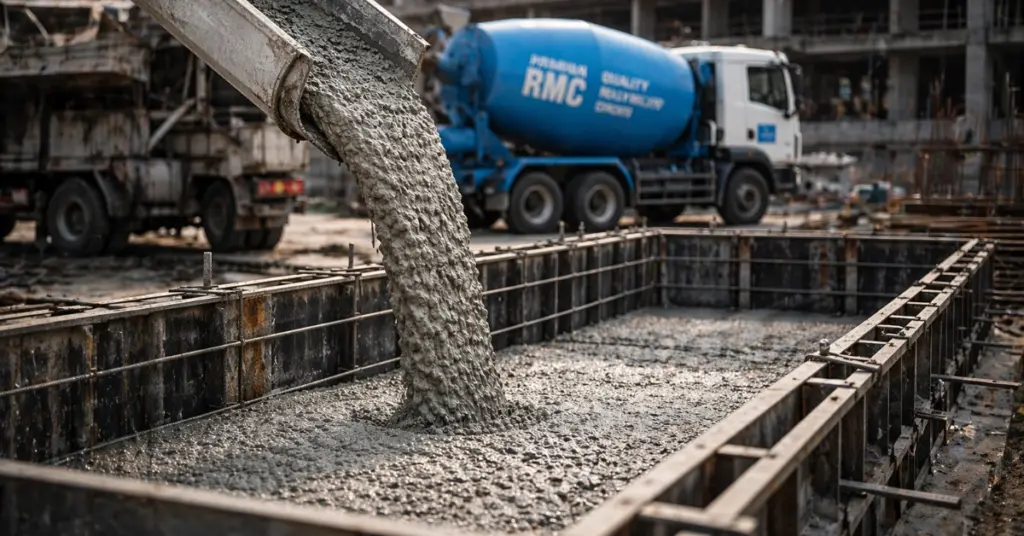
There’s one point that doesn’t get enough attention: the grade you specify is only meaningful if every batch you receive is consistent. A pour that varies between M22 and M27 across different loads isn’t really an M25 structure — it’s a structure with unpredictable strength distribution. SCADA-automated batching at an Aparna RMC plant produces the same mix proportion in every load, verified by plant-level testing before dispatch. The 28-day cube strength you’re expecting is the strength you get — pour after pour.
7. Conclusion
Concrete grade selection is a structural decision, not a procurement shortcut. The grade your structural engineer specifies is the minimum your project requires — and matching it precisely, consistently, across every pour is what Aparna RMC is built to deliver. With grades from M30 to M80, automated batching, and technical support across its plants in five states, Aparna RMC takes the guesswork out of grade selection and makes consistent delivery the standard, not the exception.
Not sure which grade your project needs? Aparna RMC’s technical team can review your structural requirements and recommend the right grade for every element. Get a quote at aparnarmc.com/get-quote or call 18001216229.
8. FAQs
Q1: What is the minimum concrete grade for a residential slab in India?
IS 456 specifies M20 as the minimum grade for reinforced concrete structural members, including residential slabs and columns. For individual house builders, M20 grade concrete with a properly controlled concrete ratio and adequate curing delivers reliable structural performance.
Q2: What is the difference between M25 and M30 concrete, and when should I use each?
M25 (25 MPa compressive strength) suits commercial buildings, mid-rise structures, and heavy floor slabs. M30 is used where higher durability is required — particularly for infrastructure elements, basements in aggressive soil conditions, and structures exposed to moisture or chemicals. Your structural engineer’s drawings will specify which applies to each element.
Q3: Does using a higher concrete grade always improve structural performance?
Not necessarily. A grade higher than the structural requirement delivers no performance benefit for that element and just increases cost. Over-specification is common in residential construction and adds unnecessary material cost. Match the grade to the specification — and make sure it’s delivered consistently.
Q4: How does ready mix concrete ensure a consistent grade across multiple pours?
A ready-mix concrete plant uses SCADA-automated batching to weigh and proportion every ingredient to the approved mix design for every batch. Unlike site mixing, where proportions shift with each load, RMC plants produce the same concrete ratio in every cubic metre — verified by plant testing before dispatch.