
Inside a Concrete Pour: The Complete Timeline of a Single Ready Mix Concrete Delivery
May 25, 2026
1. Introduction
Most contractors think of a concrete pour as starting when the transit mixer pulls onto the site. It doesn’t. The decisions that determine whether that pour succeeds or fails were made hours earlier — at the batching plant, during mix design sign-off, and in the logistics planning that set the pour window. Understanding what happens across the full timeline of a ready-mix concrete delivery gives you control over the outcome at every stage, not just the ones you can see.
Here is exactly what happens, from the moment an order is placed to the moment concrete reaches its final position.
2. T-Minus 24–48 Hours: Order Confirmation and Mix Design
A concrete pour starts with a conversation between the site engineer and the readymix concrete supplier. This is where the pour is planned — not managed on the day. The order confirmation locks in four critical variables: the concrete grade required, the volume in cubic metres, the required slump, and the pour window — the time period during which site conditions, labour, and equipment are all ready.
At Aparna RMC, this triggers the concrete mix design process at the relevant plant. The mix design is not a generic one-size-fits-all — it’s calibrated to the specific grade, slump, and delivery conditions of your pour. Admixtures are selected based on pour timing, ambient temperature, and structural requirements. If the pour is scheduled during peak summer, a retarder may be added to extend the working window. If it’s a mass pour, a temperature-controlled mix manages the heat of hydration. The design is signed off before the first ingredient is loaded.
3. T-Minus 2 Hours: Batching Plant Preparation
Two hours before dispatch, the RMC plant begins final preparation. Aggregates are measured and loaded into the batching system. Cement from silos is weighed. Water is measured precisely against the approved water-cement ratio. Admixtures are dosed to specification.
At an Aparna RMC plant, this entire process runs through SCADA-automated controls. Every ingredient is weighed to specification — not estimated. The system logs every batch against the order reference, generating the batch certificate that travels with every delivery. Before the drum even starts mixing, a slump test is conducted on the fresh concrete at the plant. If the slump falls outside the specified range, the batch is adjusted or rejected before dispatch. The concrete that leaves the plant has already passed its first quality check.
4. T-Minus 60 Minutes: Dispatch and Transit

The transit mixer is loaded, sealed, and dispatched. From this point, the clock is running. Concrete begins hydration the moment cement meets water. The working window — the period during which the concrete remains placeable — is approximately 90 minutes under standard conditions. In summer conditions with ambient temperatures above 38°C, that window can shrink to 60–70 minutes.
Transit time is not just a logistical detail — it’s a structural variable. This is exactly why proximity to a ready-mix concrete near me source matters for every pour. Aparna RMC plants are positioned to serve urban construction sites within practical transit windows. In Hyderabad, the nearest plant is typically within 20–30 minutes of any active construction zone in the city.
5. T: Arrival on Site and Pre-Pour Checks
The transit mixer arrives. Before a single cubic metre is discharged, three things must happen.
a. Delivery Challan Verification
Check the delivery challan against the order — grade, volume, mix design reference, and plant batch number. This is your first confirmation that what you ordered is what arrived. Any discrepancy gets resolved before discharge begins, not after.
b. On-Site Slump Test
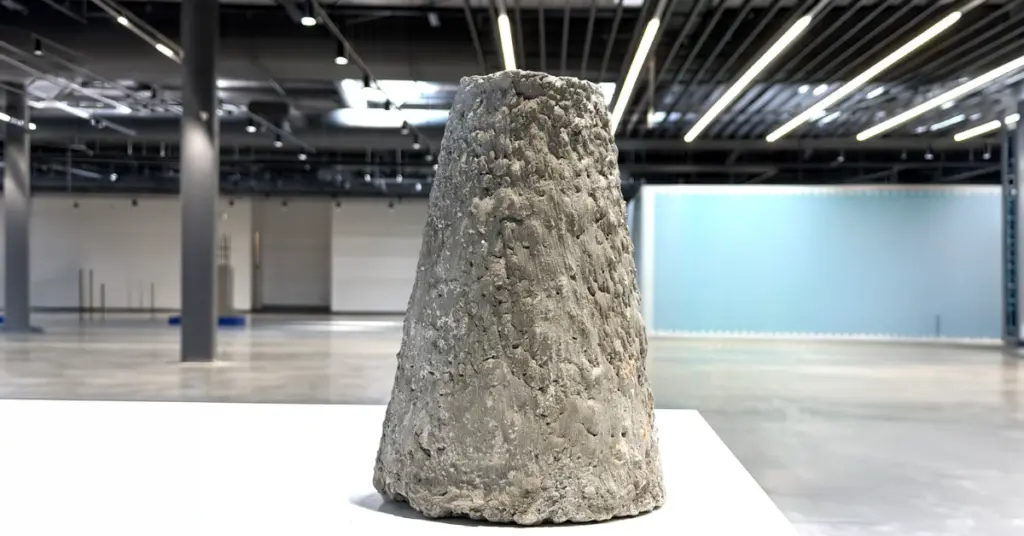
A sample of concrete is drawn from the drum, placed into a standard slump cone, and the cone is lifted. The distance the concrete settles is measured. If the on-site slump reading falls outside the specified range, the load is flagged before it enters the formwork.
c. Cube Sample Collection
Six standard 150mm cube moulds are filled from the same sample batch, sealed, labelled with the pour date, element, and batch reference, and set aside for curing. These cubes are your quality record — the objective proof of what was poured in this element, from this batch, on this date. Three cubes are tested at 7 days, three at 28 days.
6. T+15 to T+90 Minutes: Active Pouring and Compaction
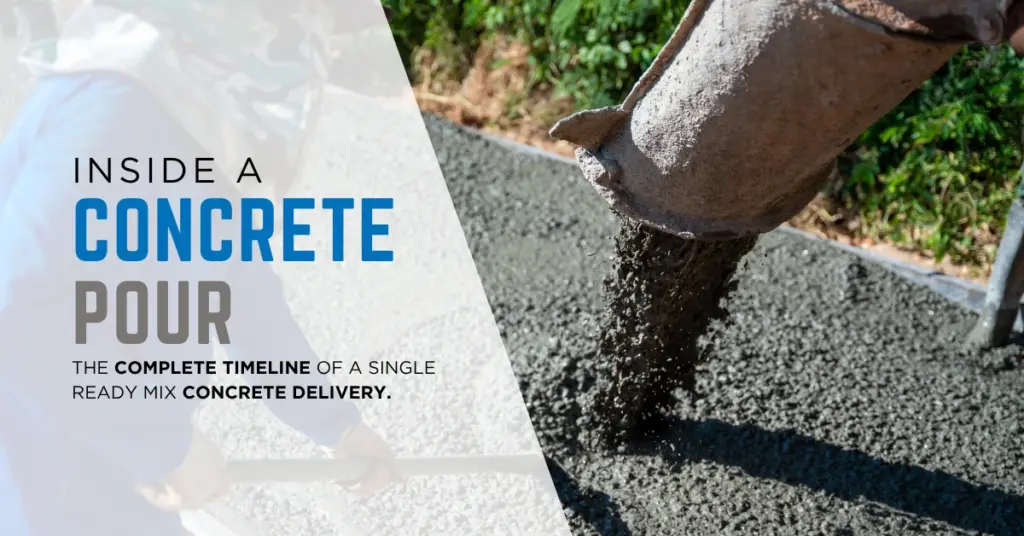
Discharge begins. Concrete flows from the drum into the pump hopper, through the pump line, and into the formwork. The rate of discharge is controlled against the pace of placement and compaction — discharge too fast and concrete builds up faster than it can be properly placed; too slow and the mix begins to set in sections.
For slab pours, concrete is placed in layers and spread with a screed board. For columns and walls using conventional concrete, each pour layer is consolidated to eliminate air voids and ensure the mix fully surrounds the reinforcement. For pours using self-compacting RMC concrete, the mix flows into place and self-consolidates without mechanical compaction — eliminating honeycombing risk in dense rebar zones.
7. T+90 Minutes: Final Placement and Surface Finishing
The last cubic metre is discharged, the drum is washed, and the mixer departs. The concrete surface is screeded level, floated to close the surface, and — for floor slabs — finished to the specified surface texture. The concrete is now in its most vulnerable state. Everything that happens in the next seven days determines the strength it reaches at 28 days.
8. T+0 to T+7 Days: Curing
Curing begins the moment placement is complete. The concrete surface is covered immediately with wet hessian or polythene sheeting to trap surface moisture. Water is applied at regular intervals — typically morning and evening — for a minimum of seven days. In peak summer conditions, additional shading prevents rapid moisture evaporation from exposed surfaces.
For large raft foundations or thick retaining walls, internal temperature monitoring may be warranted. Temperature control concrete is specifically formulated for these high-risk mass pour situations, managing heat of hydration through the critical early curing phase to prevent thermal cracking.
9. T+7 Days: First Cube Test
The 7-day cube samples go to the lab. Results should come in at approximately 65–70% of the expected 28-day strength. An M25 mix should read around 16–18 MPa in 7 days. If results fall significantly below this, it flags a problem — with the mix, the curing, or the cube preparation — that can be investigated before the next pour proceeds.
10. T+28 Days: Final Strength Verification
The 28-day cubes are tested. This is the definitive quality record for the pour. The result is documented and filed against the structural drawings reference, becoming part of the project’s quality assurance record. If the result meets or exceeds the specified grade, the element is verified. If it falls short, the structural engineer is notified and remediation options are assessed.
This complete quality loop — from mix design through to 28-day test result — is what separates a properly managed concrete pour from one that just hopes for the best.
11. Conclusion
A concrete pour isn’t a single event — it’s a sequence of interdependent decisions that begins at the batching plant and ends four weeks after the formwork is struck. Every stage in that sequence has a defined standard, and every departure from that standard creates a risk that compounds downstream. Aparna RMC manages the plant end of that sequence with the rigour it requires — SCADA-automated batching, pre-dispatch testing, VTS-tracked transit, and batch-certified delivery across its plants in five states.
Ready to take the guesswork out of your next pour? Get a quote at aparnarmc.com/get-quote, use the RMC Calculator at aparnarmc.com/rmc-calculator to plan your volumes, or call 18001216229 to speak with a technical team member.
12. FAQs
Q1: How far in advance should I order ready-mix concrete for a pour?
Confirm your order at least 24–48 hours before the pour. This gives the plant time to prepare the correct mix design, schedule production, and allocate transit mixers to your pour window — particularly important during peak construction months when plant scheduling is tight.
Q2: What is a slump test and why does it matter at the point of delivery?
A slump test measures the workability of fresh concrete — how easily it flows and fills formwork. A slump that’s too high indicates excess water in the mix, which reduces compressive strength. Too low means the concrete may not compact fully, leading to voids. The on-site slump test is your quickest check that the concrete delivered actually matches the specification.
Q3: Why does concrete need to be tested at both 7 days and 28 days?
The 7-day test gives you an early read on strength development — roughly 65–70% of the final 28-day strength — so problems can be identified before the next structural element is poured. The 28-day test is the definitive measure of whether the concrete met its specified grade, and forms the permanent quality record for that pour.
Q4: What happens if the transit mixer is delayed and the concrete arrives past its working window?
If concrete arrives beyond its working window, it should not be placed. Adding water to restore workability reduces compressive strength and compromises the pour. The right call is to reject the load and coordinate a replacement with the supplier. This is precisely why plant proximity and VTS tracking of each load matters — so delays are flagged early enough to manage before they become a rejection on site.