
Green Concrete: What It Is, How It’s Made & Why It Matters
July 16, 2026
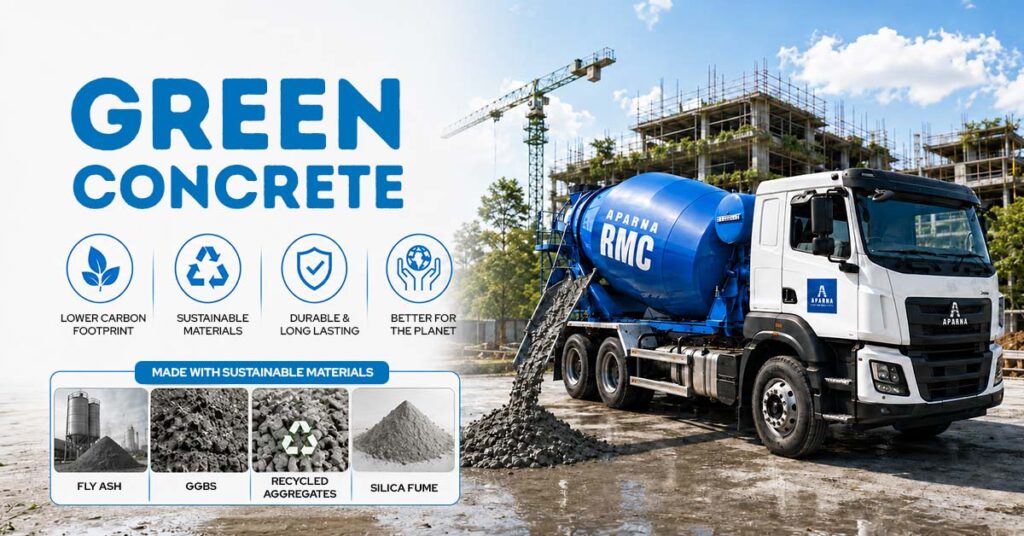
Green concrete is a special type of concrete that is designed to reduce environmental impact. It is achieved by replacing part of the Portland cement with industrial by-products like fly ash and Ground Granulated Blast Furnace slag (GGBS) and using recycled aggregates and water.
Cement production accounts for roughly 7–8% of global CO2 emissions, [1] and nearly all of concrete’s carbon footprint traces back to its cement content.
This article discusses what green concrete is, what it is made of, how it compares with conventional concrete, and how it earns green-building credits in India.
Key Takeaways
- Green concrete cuts CO2 emissions by replacing 25–70% [2] of Portland cement with fly ash or GGBS – supplementary cementitious materials (SCMs)
- A well-designed green concrete matches or exceeds conventional concrete’s long-term strength and durability.
- Green concrete mixes help projects earn IGBC, GRIHA and LEED credits for recycled content and lower embodied carbon.
What Is Green Concrete?
Green concrete is an eco-friendly alternative to traditional concrete, which is high–carbon cement. The main goal of green concrete is to reduce carbon emissions during manufacturing and minimise the use of virgin material. This is achieved through the mix design, not a completely new product. It contains the same cement, aggregate, and water, but proportions differ. The concept was initially formalised in Denmark in the late 1990s but now it is widely used.
What Green Concrete Is Made Of?
Green concrete is not completely free from conventional ingredients. Only a certain portion of specific components gets substituted for lower-carbon or recycled alternatives.
It is made of:
- Fly ash
- GGBS
- Silica Fume
- M-Sand
- Recycled concrete
- Recycled water
The table below shows substitution, what it replaces, and the replacement level used in practice:
| Material | Replaces | Typical Replacement Level | Key Benefit |
| Fly Ash | Portland Cement | 15–35% by weight of cement | Improves workability and reduces embodied carbon. |
| GGBS | Portland Cement | 25–70% by weight of cement | Improves durability and reduces embodied carbon |
| Silica Fume | Portland Cement | 5–10% by weight of cement | Delivers strength and keeps water out. |
| Recycled Concrete Aggregates | Crushed/recycled concrete chunks | Up to ~20–25% for structural use; higher for non-structural | Cuts down on landfill waste. |
| M-Sand | River Sand | Up to 100% | Protects river ecosystems and provides consistent sizing. |
| Recycled Water | Fresh Water | As permitted under applicable water-quality provisions | Saves freshwater resources. |
Note: Replacement levels shown are indicative ranges based on IS 3812, IS 16714, and IS 15388; actual proportions are determined by mix design and verified through cube testing at the batching plant.
Standards Referenced
Green concrete practice in India draws on several IS standards, including IS 456 (concrete code), IS 3812 (fly ash), IS 12089/IS 16714 (GGBS), IS 383 (aggregates including recycled), and IS 15388 (silica fume).
Disclaimer: Replacement levels and clause references are indicative and may vary with the current edition of each standard. Please confirm exact figures for project-specific specifications.
Green Concrete vs Conventional Concrete
The differences show up in cement content, carbon footprint, strength development, and durability
| Parameter | Conventional Concrete | Green Concrete |
| Cement content | 100% OPC | 30–75% OPC + SCMs |
| Embodied CO2 | Baseline | Typically 20–40% lower, mix-dependent |
| Early strength | Faster | Slower with high SCM content |
| Long-term strength | Baseline | Equal or higher at 56–90 days |
| Durability | Baseline | Generally better — lower permeability, lower heat of hydration |
| Cost | Baseline | Comparable; SCMs are often cheaper than cement, but QC matters |
| Availability | Universal | Depends on SCM supply and a capable batching plant |
Green concrete takes longer to harden, and it is a normal trait, not a defect. Because of this slow start, construction teams must adjust their project schedules and keep the building molds (formwork) in place longer.
Benefits of Green Concrete
- Lower carbon footprint: Every tonne of cement produced releases around 0.9 tonnes of CO2. Replacing cement with SCMs reduces embodied carbon.
- Uses industrial waste: Fly ash and slag that would otherwise go to landfill become a useful binder instead.
- Equal or better durability: SCM concretes have lower permeability and better resistance to sulphates and chlorides, which is why coastal and infrastructure projects prefer them for performance, not just sustainability.
- Better workability and pumpability: Fly ash’s spherical particles improve flow at the same water content, a practical gain on high-rise and long-pump projects.
- Lower heat of hydration: Reduces thermal cracking risk in large pours such as rafts and mass foundations.
- Conserves natural resources: Less limestone mining, less river sand dredging, less quarrying overall.
- Conserves water: Treated or recycled batching water reduces freshwater demand, a benefit distinct from aggregate conservation and one that’s relevant to certification documentation.
- Green-building credits: Contribute to IGBC, GRIHA, and LEED points, covered in detail in the certification section below.
Considerations of Green Concrete
- Longer Setting Time: Reaches full strength later, requiring adjusted construction schedules.
- Material Sensitivity: Requires strict quality checks due to variable raw materials.
- Strict Curing Needs: Demands rigorous moisture management to reach full strength.
- Localised Supply: Availability depends entirely on regional industrial production.
Green Concrete and Green Building Certifications in India
Green concrete mixes can contribute toward material-related credits under IGBC, GRIHA, and LEED (administered in India through IGBC), which recognise recycled content, responsible material sourcing, and lower embodied carbon.
Disclaimer: Specific credit categories and point values vary by rating system and manual version. Consult the current IGBC/GRIHA/LEED rating manual or a certified green-building consultant for project-specific credit eligibility.
Where Green Concrete Actually Gets Made — the Batching Plant
Green concrete is made only in a plant and exists only as a designed mix. The SCM percentages, recycled aggregate ratios, and water controls are set during mix design and executed at a batching plant with weigh-batching and material testing. Site-mixed concrete cannot reliably produce it.
Aparna RMC designs and supplies green concrete from its batching plants across all its locations. Fly ash and GGBS mixes designed and batched by weight, with material and cube testing at each stage.
Builders and developers planning projects with sustainability targets can contact Aparna RMC for a green mix consultation.
Disclaimer: Figures and historical references in this article are provided for general informational purposes and are based on commonly cited industry sources. For technical specifications, compliance, or certification decisions, please verify with current IS codes, rating manuals, or Aparna RMC’s technical team.
Frequently Asked Questions On Green Concrete
Is green concrete as strong as normal concrete?
Yes, green concrete can be as strong as normal if properly designed. SCM mixes gain strength more slowly but match or exceed conventional concrete by 56–90 days, with better durability. Strength comes from the mix design, not the label.
Is green concrete more expensive?
Cost is generally comparable to conventional concrete, though it can vary by project, mix design, and material availability. For a project-specific cost comparison, please contact Aparna RMC for a quotation.
What is the difference between green concrete and green cement?
Green cement is the eco-friendly ingredient, while green concrete is the finished product. Green cement reduces the clinker content — clinker is the carbon-intensive part — typically by blending in SCMs or calcined clay. It does not work by eliminating limestone. In simple terms, green cement is an ingredient, and green concrete is the product.
Is geopolymer concrete the same as green concrete?
Geopolymer concrete is a type of green concrete, but a distinct one. Conventional green concrete keeps Portland cement and replaces a portion of it with SCMs; geopolymer uses zero Portland cement, activating fly ash or slag with alkaline activators instead. All geopolymer is green concrete; not all green concrete is geopolymer.
Can green concrete be used for houses and apartments?
Yes, green concrete is used to construct modern houses and apartments. Its applications include slabs, columns, and foundations.
Does Aparna RMC offer Green Concrete?
Yes, Aparna RMC offers green concrete under the name AstraGlowCrete. This special ready-mix concrete replaces a portion of traditional cement with puzzolanic material such as Fly Ash / GGBS and offers lower heat of hydration.