
What Is Lightweight Concrete? Types, Advantages & Where It’s Used
July 28, 2026
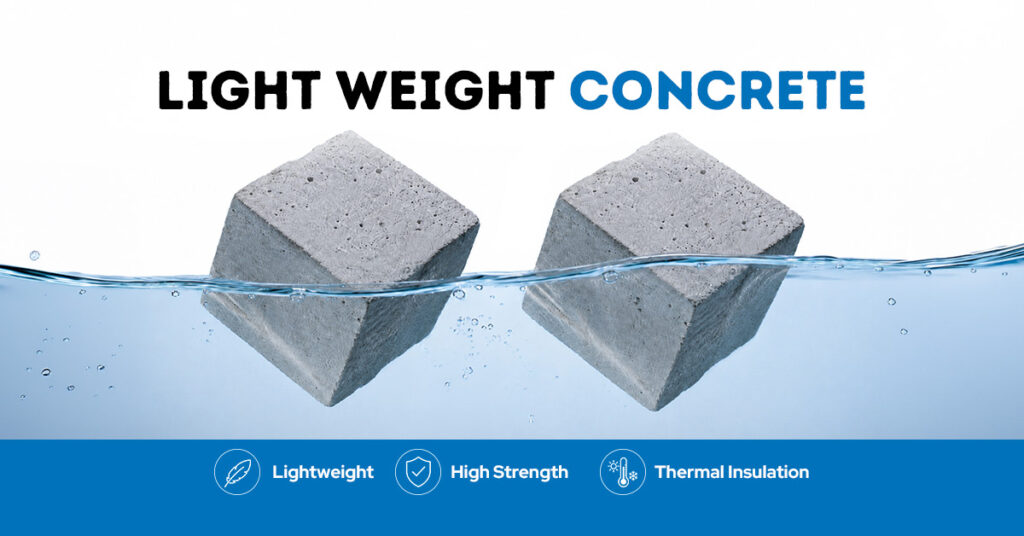
Lightweight concrete (LWC) is a specialised ready-mix concrete that has a lower density than normal concrete. The density ranges from 300 to 1,840 kg/m³, which is lower than that of conventional concrete (2,300–2,400 kg/m³).
This lower unit weight is achieved by the use of lightweight aggregates like clay, pumice, perlite, or sintered fly ash. LWC is also produced by trapping air or gas bubbles inside the mix via foaming or autoclaving.
LWC reduces the dead load on structural frames, offers superior thermal insulation, and enhances fire resistance when compared to conventional concrete.
In India, this concrete is used for high-rise residential towers, precast panel systems, blocks, roofs, and terrace insulation layers. This specialised concrete is increasingly supplied as ready-mix by producers such as Aparna RMC.
Types of Lightweight Concrete
Lightweight concrete is classified into two types: by production method, and density & strength range.
By Production Method
- Lightweight Aggregate Concrete (LWAC): It is produced by replacing natural aggregates with expanded clay, expanded shale or slate, pumice, perlite, vermiculite, or sintered fly-ash aggregates.
- Cellular Lightweight Concrete & Autoclaved Aerated Concrete: This concrete is made by trapping tiny air bubbles inside a cement mix using two methods:
- Cellular Lightweight Concrete (CLC): In this method, pre-made foam is directly added to the cement slurry.
- Autoclaved Aerated Concrete (AAC): Produced through a chemical reaction between aluminium powder and alkaline slurry, releasing hydrogen gas that expands the mix.
The density of concrete produced through these methods ranges between 400 and 800 kg/m³.
- No-Fines Concrete: This type is produced using only coarse aggregate, and it completely lacks fine aggregate (sand). The concrete thus produced is porous and open-textured and is primarily used for drainage layers, permeable paving, and cavity-fill applications.
By Density & Strength
Lightweight concrete is sub-classified into three concrete categories – low-density (insulating), moderate-density (semi-structural), and structural density.
Any concrete with an oven-dry density under 2,000 kg/m³ is considered lightweight, as per Eurocode 2 (EN 1992-1-1)
The table below compares all lightweight concrete types by density, unit weight, and grades.
Density, Unit Weight & Grades
Category |
Density (kg/m³) |
Unit Weight (kN/m³) |
Grade Notation |
Typical Use |
| Low-density/insulating | 300–800 | 3.0–7.8 | — | Thermal insulation, screeds, void fill |
| Moderate-density | 800–1,350 | 7.8–13.2 | LC8–LC15 | Blocks, partitions, semi-structural |
| Structural LWC | 1,350–1,840 | 13.2–18.0 | LC20–LC60+ | Load-bearing slabs, precast, high-rise |
| Normal-weight (reference) | 2,300–2,400 | 22.6–23.5 | C20–C60 | Conventional RCC |
Lightweight Concrete Materials
Aggregate |
Source |
Density (kg/m³) |
Usage |
| Pumice | Natural volcanic rock | 480–900 | Blocks, low-density LWAC |
| Perlite | Expanded volcanic glass | 30–240 | Insulating fills, plaster mixes |
| Vermiculite | Exfoliated mineral | 60–130 | Fireproof coatings, insulating screeds |
| Expanded clay / LECA | Kiln-fired clay pellets | 300–700 | Structural LWAC, drainage |
| Expanded shale/slate | Kiln-fired shale | 500–900 | Structural LWAC |
| Sintered fly-ash aggregate | Fly ash sintered under heat | 700–1,000 | Sustainable LWAC |
| Foamed slag | By-product of iron smelting | 600–1,000 | Blocks, semi-structural |
Role of Admixtures & Foaming Agents
Lightweight concrete requires admixtures, such as foaming agents and air-entraining agents, to create small air bubbles in the mix. The foam is mixed with water and air before it is added to wet cement. Also, high-range water reducers or superplasticizers are added to make concrete easy to pour without extra water. The size of the air bubble determines the concrete strength.
How Lightweight Concrete Is Made: Step-by-Step
Pre-soak Aggregates
Batch & Weigh Materials
Mix Thoroughly
Place with Care
Cure for Strength
Lightweight Concrete Mix Design & Ratio
Lightweight concrete mix design follows the same basics as normal concrete. It can be customised to achieve specific strength and durability, but extra variables are added. So, there is no fixed mix ratio.
Key Design Variables
- Target density: The target concrete weight depends on your project’s structural requirements. So, aggregate and cement choices are selected based on your needs.
- Target strength: Structural concrete needs higher strength. To achieve this, less water and denser aggregates like expanded shale are used instead of pumice.
- Sand for Pumping: Natural sand keeps the concrete wet and slippery inside the pumps, allowing smooth flow and avoiding blockage in pump hoses.
- Admixture dosing: Use water-reducers and air-entrainers to improve workability. Ensure you do not add too much air, or else the concrete will lose its strength.
Properties & Characteristics of Lightweight Concrete
Go through the table below to understand the key properties of the LWC:
Property | What it Means |
| Thermal Insulation | Excellent, as it traps heat and cold |
| Fire Resistance | Top tier: blocks fire for up to 4 hours. |
| Acoustic Insulation | Good; blocks airborne noise effectively. |
| Lower Elastic Modulus | Flexible, bends more, and is less stiff. |
| Durability | Long-lasting; durable if kept sealed and dry. |
| Compressive Strength | 2 to 60+ MPa, (full engineering spectrum range)m, 15 MPa (non-structural insulation applications) |
Advantages of Lightweight Concrete
LWC offers advantages like reduced dead load, better thermal insulation, fire resistance, sound insulation, and easy handling.
- Reduced Dead Load: Lightweight concrete puts less weight on the building’s columns, beams, and foundations, saving overall costs.
- Better Thermal Insulation: Lightweight concrete traps millions of microscopic air pockets, acting as an excellent thermal barrier, lowering heat transfer. This improves homeowners’ comfort and saves on power bills.
- Good Fire Resistance: Lightweight concrete resists fire because its tiny air bubbles block and slow down the heat. The aggregates used are made in high-heat kilns, so they do not melt or break down in a fire. This gives the structure protection and safety during fire accidents.
- Better Sound Insulation: The porous structure of LWC traps sound, helping reduce noise between rooms and creating a quieter indoor environment.
- Easy to Transport: This concrete is easy to transport, lift, and install due to its lightweight, accelerating project completion and reducing labour costs.
Lightweight Concrete Disadvantages
Lightweight concrete comes with a few limitations that you need to know before using it.
- Longer Drying and Curing Time: It takes more time for lightweight concrete to dry and achieve its maximum strength because it holds moisture more than ordinary concrete.
- Higher Shrinkage and Lower Stiffness: Engineers must add more reinforcement steel to prevent concrete cracking and deflection because lightweight concrete is stiff and shrinks more as it dries, causing it to flex and sag more under strong structural loads.
- Higher Material Cost: The material cost is higher because aggregates are more expensive than sand and stone. The porous aggregates absorb more water, requiring specialised mixes and experienced labour.
- Care Required During Placement and Pumping: Handling the LWC during mixing, pumping, and installation requires proper care to ensure a strong finish and avoid segregation.
Applications & Uses of Lightweight Concrete
Structural Applications
- High-rise floors and slabs: For floor slabs in tall structures, structural LWC (LC30–LC50) is used for lower column sections, lighter foundations, and more stories without changing the structural frame.
- Bridges and elevated structures: Structural lightweight aggregate concrete lowers superstructure weight and can extend possible spans in situations where minimising dead loads is crucial for span geometry or bearing capacity.
- Precast lightweight concrete panels: Lightweight aggregate concrete is used to cast wall panels, cladding units, and facade components to reduce crane lift weights and streamline on-site installation operations.
Non-Structural Applications
- Lightweight concrete blocks: In India, partition walls and external infill panels in framed construction are the most common non-structural uses for CLC and AAC blocks. They act as a substitute for clay brick due to their low heat conductivity and simplicity of cutting.
- Terrace and roof insulation: In Indian residential and commercial buildings, low-density LWC (300–800 kg/m³) is applied as an insulating screed over structural roof slabs to minimise heat gain, especially on flat terraces.
- Screeds and floor levelling: Compared to sand-cement screed, moderate-density LWC offers a lighter levelling layer over structural slabs, lowering the loads placed on upper floors.
- Void filling and sub-base: Cavities, abandoned tunnels, and spaces beneath slabs where little self-weight addition is required are filled using low-density foamed concrete.
Indian Standards & Codes for Lightweight Concrete
In India, lightweight concrete specifications are regulated by the Bureau of Indian Standards (BIS). Various BIS standards also specify the requirements for lightweight concrete materials and products.
Standard | Purpose |
| IS 9142 (Part 1) | Covers lightweight aggregates used in concrete [Sintered fly ash coarse aggregate] |
| IS 9142 (Part 2) | Pre-formed expanded clay aggregate |
| IS 2185 (Part 3) | Standard for AAC blocks |
| IS 2185 (Part 4) | Standard for CLC blocks |
| ACI 213R | Guide for structural lightweight concrete |
| IS 456 | Plain/Reinreinforced concrete |
Takeaway
Lightweight concrete is a building material with a density ranging between 300 and 1,840 kg/m³. Its lower weight lessens structural load and offers good thermal insulation. Depending on the mix, LWC can be used for roof insulation, floor screeds, and load-bearing structural elements.
With demand for high-rise buildings, lightweight concrete is becoming a preferred option. It is easy to handle, offers long-term benefits, and provides improved performance.
Aparna RMC offers high-quality lightweight concrete for both structural and non-structural applications, including commercial and residential projects.
Disclaimer: This article is intended for general informational purposes only. Always consult a qualified engineer or relevant professional before making structural or construction decisions.
Frequently Asked Questions On Lightweight Concrete
Yes, structural lightweight concrete can achieve a compressive strength of 15 MPa, and it can be extended up to 60 MPa or higher. Non-structural grades do not bear load and are only used for void filling.
No, it is not waterproof because it is more porous than regular concrete. If left unprotected, the open-pore structure of cellular mixtures and lightweight aggregates allows water ingress. So surfaces exposed to moisture must have a waterproofing membrane.
As porous particles hold more water, lightweight concrete requires a longer drying time. Light foot traffic is usually safe after 24 to 36 hours. For structural loading, the waiting period is 7 to 28 days, depending on grade.
No, it doesn’t crack if proper care is taken. Inadequate curing may result in cracking, and it can be avoided by pre-soaking aggregates, prompt use of curing agents, and proper joint spacing.
No, lightweight concrete costs more, as it uses more expensive ingredients. But it can lower the total project cost through reduced steel use, lighter foundations, and cheaper handling.
Lightweight concrete lasts for decades with the right mix design. However, the durability can be reduced in wet conditions if the porous surface is left unsealed.
Yes, it is one of its most common applications for slabs and floor systems. LWC reduces dead loads on supporting beams and columns and improves thermal insulation.
Lightweight concrete has a minimum density of about 300 kg/m³. This kind is mostly utilised for non-load-bearing floor screeds, thermal insulation, and filling in gaps. It is not appropriate for load-bearing or structural applications due to its extremely low strength.
Categories
Recent Posts
- What Is Lightweight Concrete? Types, Advantages & Where It’s Used
- What Is Glass Fiber Reinforced Concrete (GFRC)? Properties, Uses & Benefits
- Green Concrete: What It Is, How It’s Made & Why It Matters
- What Really Happens Between Ordering Ready Mix Concrete and the First Pour?
- The Cost of a 30-Minute Delay: Why Timing Matters in Concrete Construction
Connect with us