
Why Delays in Concrete Delivery Destroy Project Timelines (And How to Avoid Them)

May 28, 2026
1. Introduction
A concrete pour cannot pause and resume. Once it starts, it continues until the element is complete — or the project has a serious problem. A delay in ready-mix concrete delivery mid-pour doesn’t create an inconvenience. It creates a cold joint: a structural discontinuity where fresh concrete meets partially set concrete, forming a plane of weakness that no amount of remediation fully eliminates.
Beyond cold joints, delivery delays idle labour, stall downstream trades, trigger penalty clauses, and compound into project-wide timeline failures that end up costing far more than the concrete itself. Here’s why delays happen, what they actually cost, and the specific steps that prevent them.
2. Why Concrete Delivery Delays Happen
Most delivery delays share a common root. They’re not random — they’re predictable failures in planning, supplier capacity, or logistics. Understanding which category your risk falls into is where prevention starts.
a. Supplier Plant Capacity

The most overlooked cause of delivery delay is insufficient plant capacity at peak demand. Indian construction activity clusters heavily around certain months — particularly the post-monsoon period from October to February. A single RMC plant serving multiple major projects simultaneously faces production scheduling constraints that push your pour window back by hours. A supplier with one plant has a fixed production ceiling. When demand exceeds that ceiling, somebody waits — and the contractor with the least leverage waits longest.
b. Transit Distance and Urban Traffic
The distance between the readymix concrete plant and your site determines two things: transit time and delivery risk. A transit mixer carrying a fresh batch that should arrive in 25 minutes can easily take 55 minutes when traffic backs up around a major junction. By arrival, the working window has narrowed significantly. If multiple loads need to follow in sequence, the cascade effect on the pour schedule is immediate. Sourcing ready mix concrete near me is not about convenience — it’s about protecting the structural integrity of your pour.
c. Poor Pour Window Planning
The pour window is the period during which the site is ready, labour is in position, equipment is set, and the weather is acceptable. When this isn’t communicated clearly to the ready-mix concrete supplier in advance, production scheduling at the plant defaults to best-guess timing. Best-guess timing produces avoidable gaps between loads. For large pours requiring multiple transit mixer loads, each load should arrive with 15–20 minutes between discharge completions — a delivery cadence that needs to be agreed in advance, not sorted out on the morning of the pour.
d. Inadequate Site Preparation
Some of the most damaging delays have nothing to do with the concrete supplier. The mixer arrives on time, but the reinforcement inspection isn’t complete. Or the pump hasn’t been positioned. Or the formwork hasn’t been checked. The concrete — a perishable product with a 90-minute working window — waits while site preparation catches up. Every minute the drum sits waiting is a minute off the available pour window.
3. What Delivery Delays Actually Cost
The cost of a concrete delivery delay has several layers, and most project managers only ever calculate the most visible one.
a. Direct Remediation Cost
A cold joint in a structural slab requires breaking out the affected zone, cleaning the interface, applying a bonding agent, and re-pouring. On a 1,500 sq ft floor, this costs ₹8–15 lakh in direct work, plus the concrete volume for the re-pour itself.
b. Labour Idle Cost
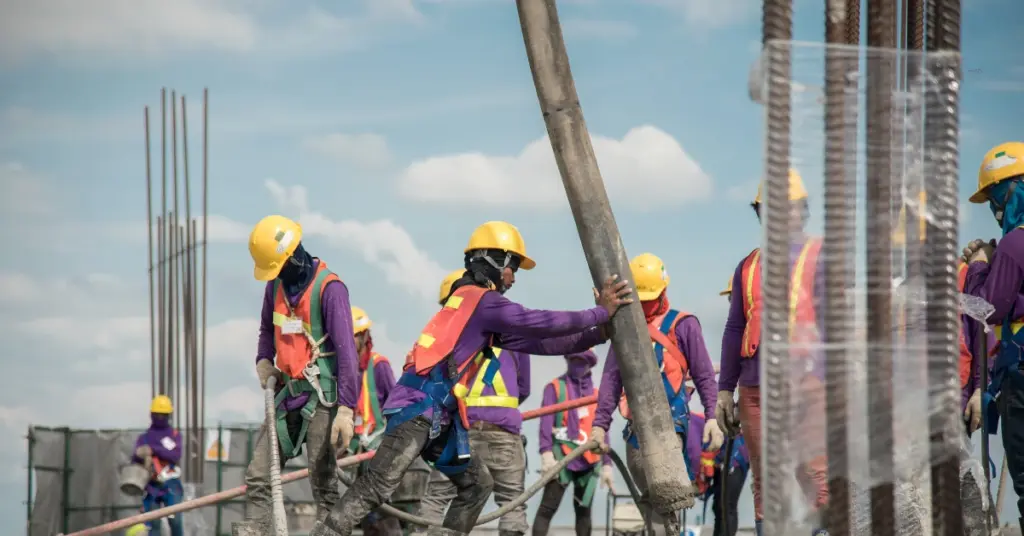
A 30-person pour crew standing by while the next load is delayed costs ₹20,000–40,000 per hour in wages, equipment hire, and lost productivity. A two-hour delay across a full pour crew on a major commercial project runs to ₹60,000–80,000 before any structural consequence is factored in.
c. Downstream Trade Delay
Concrete must be cured before formwork can be struck. Formwork must be struck before the next structural element proceeds. MEP rough-in follows the structure. Finishes follow MEP. A two-day delay in a single concrete pour, if it sits on the critical path, pushes the project completion date by two days. On a contractual handover with penalty clauses, a two-day delay at peak construction stage can cost ₹2–5 lakh per day in penalties — making the ready mix concrete price look trivial by comparison.
d. Total Project Timeline Impact
In multi-storey construction, structural floors are typically on the critical path. Every delayed concrete pour that isn’t recovered adds directly to the handover date. On a 20-storey residential project, a pattern of two-day delays per floor across 15 structural pours extends project completion by a month — and brings all the penalties that come with it.
4. How to Prevent Concrete Delivery Delays
a. Choose a Supplier With Multiple Plants
A single-plant supplier gives you one point of failure. A supplier with multiple plants in your city can reroute production to the closest available plant if one runs into a delay. For ready mix concrete in Hyderabad, Aparna RMC’s multi-plant network means that if one plant has a production issue, the adjacent plant picks up the order — without your pour being affected.
b. Use a Supplier With Vehicle Tracking
You can’t manage a pour window without knowing where your loads are. VTS — vehicle tracking systems on every transit mixer — gives you real-time visibility of each load between plant and site. When a load is running late, you know before it becomes a gap in the pour. Aparna RMC’s entire fleet of 300+ transit mixers operates with live VTS tracking, integrated into the dispatch and customer communication system. You know where your RMC concrete is before it arrives.
c. Plan Pour Windows in Detail
Share your pour plan with your supplier before the day of the pour, not on the morning. The plan should include total volume required, intended pour start time, acceptable delivery cadence between loads, and any site access constraints that affect approach or positioning. This gives the production team at the RMC plant what they need to schedule your loads correctly and protect your pour window.
d. Complete Site Readiness Before First Dispatch
Make it a hard rule: the first load is not dispatched until site readiness is confirmed. Reinforcement signed off. Pump ready. Formwork checked. Crew briefed and in position. A five-minute phone call confirming site readiness before dispatch prevents a two-hour idle on site.
e. Use the RMC Calculator for Accurate Volume Planning
Under-ordering concrete mid-pour forces an emergency top-up that can’t arrive within a safe time window. Over-ordering creates waste. Use Aparna RMC’s ready mix concrete calculator to calculate the precise volume your pour requires — accounting for element dimensions, wastage factor, and slope or taper where applicable. Order accurately, and the delivery schedule holds.
5. The Supplier Decision Is the Risk Management Decision
Every step above can be planned and controlled by the site team. But the foundation of reliable concrete delivery is choosing a ready mix concrete supplier with the plant network, fleet size, and logistics infrastructure to honour a pour window consistently — not just on a good day, but on the day your largest pour of the project is scheduled.
A supplier with one plant, 20 mixers, and no tracking system is a delivery risk on every pour. A supplier with sufficient plants, 300+ tracked mixers, and ERP-integrated dispatch is a logistics partner who protects your timeline as a matter of operational standard.6. Conclusion
Concrete delivery delays aren’t inevitable — they’re the predictable outcome of under-planning, insufficient supplier capacity, and misaligned logistics. Every one of the causes above is addressable before the pour window opens. Aparna RMC’s – wide range of network, 300+ VTS-tracked mixers, and ERP-integrated dispatch system are built to protect your pour window on every project, at every scale — because a late truck doesn’t just cost concrete. It costs everything that depends on that slab being finished on time.
Don’t let a late delivery undo weeks of site preparation. Check plant locations near you at aparnarmc.com/rmc-plant-locations, get a quote at aparnarmc.com/get-quote, or call 18001216229 to plan your next pour with our team.
7. FAQs
Q1: What causes a cold joint in concrete, and can it be repaired?
A cold joint forms when fresh concrete is placed against concrete that has already begun its initial set, typically caused by a gap between loads. Cold joints can be treated with bonding agents and patch repairs, but they remain a structural weak point. The only reliable fix is prevention: maintaining delivery cadence and ensuring each load arrives within the pour window.
Q2: How many transit mixers does a pour typically require, and how far apart should loads arrive?
This depends on the pour volume and the rate of placement. For most commercial pours, loads should arrive within 15–20 minutes between discharge completions. Your ready mix concrete supplier should schedule the delivery cadence based on your pour plan — which is why sharing the plan in advance, not on the day, is essential.
Q3: Does the distance from the RMC plant to the site actually affect concrete quality?
Yes, directly. Longer transit times shorten the concrete’s working window at the site, increasing the risk of the mix stiffening before placement is complete. In Indian summer conditions, where temperatures accelerate hydration, transit time becomes a critical quality variable — not just a logistics factor. Proximity to an RMC plant near you protects both quality and delivery reliability.
Q4: What should I do if a transit mixer arrives and the concrete has begun to stiffen?
Do not add water to restore workability — this reduces compressive strength and compromises the pour. Conduct a slump test on arrival. If the slump falls below the specified range and the mix is within its working window, discuss options with your supplier. If the load is beyond its working window, reject it and arrange a replacement. Document the rejection against the batch reference for your quality records.