
How Ready Mix Concrete Is Made: The RMC Manufacturing Process, Step by Step
September 19, 2026
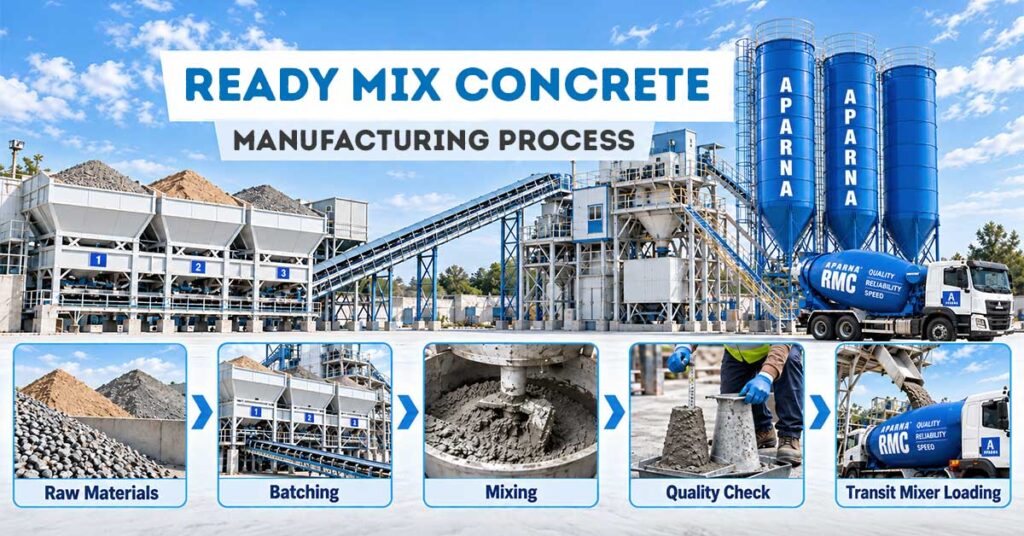
Ready mix concrete is made in a plant, not on site. Cement, sand, stone aggregate, water and admixtures are weighed to a fixed recipe, mixed under machine control, and sent out in a rotating transit mixer that must discharge within two hours of the water being added. Every load is weighed the same way, so the concrete that arrives on Tuesday matches the concrete that arrived on Monday.
That is the short answer. The rest of this page walks through what actually happens at each stage, what the plant is required to control, and where the process changes from one job to the next.
What Ready Mix Concrete Is Made Of?
Ready mix concrete is made of five things: cement, fine aggregate (sand), coarse aggregate (crushed stone), water and admixtures. Some mixes also include fly ash or slag in place of part of the cement. Nothing else goes in.
By volume, a typical mix is roughly 10–15% cement, 60–75% aggregate and 15–20% water, with a small amount of admixture and some trapped air. Most of what you are pouring is stone and sand. The cement is the smallest part by volume and the most important part by cost and behaviour.
| Ingredient | What it does | What can vary |
|---|---|---|
| Cement | Reacts with water to form the paste that binds everything together and gives the concrete its strength | Type — OPC, PPC or PSC — and grade. Chosen for the exposure and the strength required |
| Fine aggregate (sand) | Fills the gaps between the stone and makes the mix workable enough to place and finish | Natural river sand or manufactured sand (M-sand). Its moisture content changes daily |
| Coarse aggregate (stone) | The bulk of the concrete. Carries load and limits shrinkage | Size, usually 10 mm or 20 mm. Shape and grading affect how much water the mix needs |
| Water | Triggers the cement reaction and makes the mix flowable | The single most controlled quantity in the plant. Too much water means weaker concrete |
| Admixtures | Small chemical doses that keep the mix workable longer, reduce water, or slow the set for long hauls | Type and dose change with distance, weather and grade |
| Fly ash or slag | Replaces part of the cement. Improves durability and reduces heat and cement consumption | Used depending on grade, exposure and specification |
Why the proportions change from one load to the next?
They do not, in the sense that matters. The recipe — the mix design — is fixed for a given grade and stays fixed for the whole pour.
What changes is the water. Sand and stone arrive from the stockyard wet, and how wet they are changes with the weather and with which part of the pile the loader took from. That water is already in the mix before any water is added from the tank. So the plant measures the moisture in the aggregate and subtracts it from the water it adds. Two loads of the same grade can therefore take different amounts of tank water and still end up identical.
Moisture correction is one of the key controls used to maintain consistency between batches, and it is covered properly further down. If you want the full grade-by-grade picture, see our guide to concrete grades and their applications.
Why it is called “ready mix”
Because it arrives ready to place. The mixing has already happened — at the plant, or in the drum on the way — so nothing has to be batched, measured or mixed at the site. The truck reverses up, discharges, and the concrete goes straight into the formwork.
The RMC Manufacturing Process at a Glance
| Stage | What happens | What is being controlled |
|---|---|---|
| 1. Mix design | The recipe is set for the required grade and conditions | Strength, workability, durability |
| 2. Materials in | Cement, aggregates, water and admixtures are received, tested and stored separately | Material quality and contamination |
| 3. Moisture check | Aggregate moisture is measured and the batch water is adjusted | Water-cement ratio |
| 4. Weigh batching | Every ingredient is weighed to a set tolerance | Proportions |
| 5. Mixing | Materials are combined until uniform, at the plant or in the drum | Uniformity |
| 6. Checks and dispatch | Slump is checked, the delivery ticket is raised, the truck leaves | Workability at dispatch |
| 7. Transport | The drum turns throughout the journey | Time and segregation |
| 8. Site arrival | The load is re-mixed, sampled and accepted | Workability on arrival |
| 9. Records | Cubes are cast and tested at 28 days; documents are filed | Strength, traceability |
Quality control is not a stage in this list. It runs across the whole of it, and that is explained in its own section below.
Stage 1: The Mix Design
Before anything is weighed, someone decides what the concrete has to do. Strength, how far it has to travel, how it will be placed, and what it will be exposed to once it hardens.
Out of that comes a mix design — the recipe. It fixes how much cement, how much of each aggregate size, how much water and how much admixture go into every cubic metre.
There are two ways this gets agreed, and the difference decides who is answerable if the concrete underperforms:
- Designed mix — you specify the performance you need and the producer works out how to reach it. The producer carries the result. This is how most RMC is supplied.
- Prescribed mix — you specify the proportions yourself, and the responsibility for whether they deliver the strength is yours.
Most buyers want a designed mix and do not realise there was a choice. Either way, the design is proved with trial batches in the lab before it goes into production, and the plant keeps a record of every design it is currently running.
Stage 2: Materials, Testing and Storage
Nothing goes into a batch until it has been checked.
Cement is tested on arrival. Aggregates are checked for grading — the spread of particle sizes — and for silt, clay and organic matter. Water is tested for impurities. Admixtures are checked against the supplier’s specification.
Storage is part of the control, not an afterthought:
- Cement goes into sealed, weatherproof silos, one per type and grade, with no possibility of two cements mixing. Cement that picks up moisture in storage is already partly reacted and will not perform.
- Aggregates are stockpiled on free-draining ground, each size in its own bay, kept from spilling into one another. A 20 mm pile contaminated with 10 mm stone changes the grading of every batch made from it.
This is the least glamorous part of the process and the one that quietly decides whether the rest of it works.
Stage 3: Weigh Batching — Where the Precision Actually Is
This is the stage that makes ready mix concrete different from concrete mixed at a site.
Everything is weighed. Not measured by the box, not counted in headpans — weighed, on load cells, by the kilogram. And the plant is not allowed to be casually close. It has to be inside a set tolerance on every batch:
| What is weighed | Allowed variation |
|---|---|
| Cement, and fly ash or slag | ±2% |
| Aggregates | ±3% |
| Water | ±3% |
| Chemical admixtures | ±3% |
On a batch carrying 350 kg of cement, ±2% is seven kilograms. That is the whole margin. Anything outside it is a failed batch.
Those weighing systems drift, so they are checked against known weights on a schedule — mechanical systems at least every two months, load-cell systems at least every three, and admixture dispensers every month. Calibration records are kept and signed.
The moisture correction
Here is the part almost no explanation of RMC includes, and it is the reason plant concrete is consistent.
Aggregate arrives wet. That water counts. If the mix design calls for 160 litres of water per cubic metre and the sand is already carrying 30 litres of it, the plant must add 130 — not 160. Add the full 160 and you have quietly made the concrete weaker, because the water-cement ratio has gone up and nobody can see it.
So the plant measures the free moisture in the aggregate, subtracts it from the water it adds, and adjusts the aggregate weight too, because part of what it just weighed was water rather than stone.
On site, this correction is rarely made. Sand is sand, water is added by the bucket, and the mix gets wetter every time it rains. That gap is one of the reasons batch-to-batch consistency is harder to hold on site. Our page on why batching precision affects structural performance goes into what that does to the finished structure.
Modern plants run this whole sequence through an automated control system, which weighs, corrects and records each batch without an operator adjusting anything by hand. More on that in our piece on automation in RMC production.
Stage 4: Mixing — and the Three Ways It Can Be Done
Once everything is weighed, it has to be combined until every part of the batch is the same as every other part.
Where that mixing happens is a real choice, and it is worth knowing which one your supplier uses:
| Route | Where the mixing happens | What it means for you |
|---|---|---|
| Central mixed | Fully mixed in a stationary mixer at the plant. The truck only agitates it in transit | Most consistent. The plant sees the mixed concrete before it leaves. Needs a mixer at the plant |
| Shrink mixed | Partly mixed at the plant, finished in the drum on the way | A middle option. Reduces plant mixing time while still checking the mix before dispatch |
| Transit mixed | Dry materials loaded into the truck and mixed entirely in the drum during the journey | Cheapest plant setup. The concrete is not seen mixed until it arrives, so it depends most on the drum and the driver |
For truck mixing, the requirement is not a stopwatch — it is drum revolutions. The drum has to turn at least 60 times at mixing speed, and that speed has to be at least 7 revolutions a minute. Turn it fewer times and the batch is not uniform; turn it far more and you start working air and water out of it.
One correction worth making: you will often read that concrete is mixed for “30 to 90 seconds”. There is no fixed mixing time in the Indian code for a plant mixer. It is whatever the mixer manufacturer specifies for that machine, and the machine’s ability to produce a uniform batch is proved by a formal efficiency test at least once a year. The fixed number is the truck-mixer revolution count, not a stopwatch reading.
Stage 5: Checks Before the Truck Leaves
Before dispatch, the fresh concrete is checked — workability first, because it is the one property you can see and the one that tells you whether the batch behaved. Temperature is noted where it matters.
Then the delivery ticket is raised, and this document is more important than most buyers realise. It is your evidence of what you bought. A proper ticket carries:
- The plant, the ticket serial number and the date
- The truck number
- The grade and the target workability
- The minimum cement content and the cement type and grade
- The maximum free water-cement ratio
- The maximum aggregate size
- The admixture used
- The quantity in cubic metres
- The time of loading
- Space for the site to record arrival time, discharge completion time, anything added on site, and where it was poured
If a pour is ever questioned — a cube fails, a slab cracks, a certifier asks — the delivery tickets are the primary record of what was supplied and when. They will not resolve a dispute on their own, but without them there is very little to work from. Keep them, and fill in the site half.
For what happens between placing the order and the truck arriving, see ordering and scheduling a pour.
Stage 6: Transport, and the Two-Hour Clock
The drum keeps turning all the way to site. That is not to keep mixing it — it is to stop the stone settling out of the mix and the whole load separating.
Under IS 4926, concrete is generally required to be discharged within two hours from the time water is added to the mix. Not from when the truck leaves the gate — from when the water went in.
A longer period is permitted where the mix has been specifically designed to maintain the required properties for it, typically with a retarding admixture or by chilling the concrete. Both are normal practice for long hauls and hot weather. But that is a deliberate decision taken at the plant when the batch is designed, not something arranged at the site when the truck is running late.
A common error worth flagging: a great deal of material written about ready mix concrete quotes a “90-minute rule”. That figure comes from an American standard. In India, the applicable limit under IS 4926 is two hours, subject to the conditions stated above.
For the full journey from plant to placement, see the complete delivery timeline.
Stage 7: Arrival, Re-Mix and Acceptance
The truck arrives. Before anything is discharged, concrete that was mixed at the plant is re-mixed in the drum for at least two minutes, so that whatever settled on the way is brought back into suspension.
Then the load is sampled — and there is a correct way to do it, which almost nobody follows:
- Let the first one-third of a cubic metre discharge and discard it. The front of the load is not representative.
- Take at least four separate scoops from across the rest of the load, not one bucket from one moment.
- Do not sample the last cubic metre
The sample is checked for workability. If a 100 mm slump was specified, the load is acceptable within ±25 mm — or within one-third of the specified value, whichever is the smaller window. Cubes are cast from the same sample for strength testing later.
Who can add water at the site?
Nobody, by default.
Once the concrete leaves the plant, no extra water goes into that drum beyond what was needed for the specified workability — unless the purchaser asks for it and signs for it. It is written down because adding water is the fastest way to destroy a load, and because when the cubes fail six weeks later, somebody needs to know who made that call.
If a load has genuinely stiffened in transit, the correct fix is usually an additional dose of admixture, agreed between the producer and the buyer. Not a hosepipe.
Where manufacturing ends?
It ends here.
Placing, compacting, finishing and curing are site operations. They are governed by a different code and carried out by a different party, and they are outside the scope of ready mix concrete manufacturing entirely.
This matters more than it sounds. Most explanations of the RMC process run straight through to curing, which blurs the line of responsibility. The producer is answerable for the concrete up to the point of discharge. What happens after that — how it is vibrated, how long it is cured — determines whether that concrete performs, and it belongs to the site.
How Quality Is Controlled Across the Whole Process?
Quality control is not step 4 of 9. It runs in three layers, all the time, in parallel with everything above.
| Layer | When | What it covers |
|---|---|---|
| Before production | Materials arriving | Cement, aggregate, water and admixture testing. Mix designs and trial batches. Equipment calibration |
| During production | Every batch, every load | Moisture correction, batch weights inside tolerance, mixing, workability at dispatch and at site |
| After delivery | Days and weeks later | Cube strength at 28 days, batch records, delivery tickets, corrective action |
The third layer is the one people mean when they say “concrete testing”, and it is also the one that arrives too late to save a bad pour. By the time a 28-day cube result comes back, the slab has been standing for a month. Which is exactly why the first two layers exist.
On testing frequency, the minimum is one sample for every 50 cubic metres produced, or every 50 batches, whichever comes round sooner — with three cubes cast from each sample for the 28-day test. Batching records, delivery tickets, calibration records and test results are kept for at least a year.
Our detailed piece on how RMC is tested for strength covers the test methods themselves.
What Changes Between Plants, Grades and Sites?
The sequence above is the same everywhere. What varies is the detail.
- By plant type. A plant with a stationary mixer produces central-mixed concrete and sees the mix before it leaves. A dry-batch plant loads the materials and lets the drum do the work. Both are legitimate; they cost differently to build and behave differently.
- By grade. Higher grades carry more cement, a lower water-cement ratio, and often fly ash or slag replacing part of it. More checkpoints, tighter margins.
- By distance and season. A pour forty kilometres away in May and one four kilometres away in December do not get the same admixture dose. Retarders go up for long hauls and hot weather, and chilled water is sometimes used to bring the load temperature down. See temperature-controlled concrete.
- By exposure. A coastal structure and an internal column are specified differently, and that feeds straight back into the mix design at stage 1.
None of this changes the process. It changes the numbers inside it.
How Aparna RMC Manufactures Ready Mix Concrete?
Aparna RMC operates 36 plants across Telangana, Andhra Pradesh, Karnataka, Tamil Nadu and Maharashtra, all built on Schwing Stetter batching equipment.
Concrete is batched through an automated control system, tested in a central laboratory, and delivered through an owned fleet of 350 transit mixers, 70 concrete pumps. Trial mixes are carried out and tested before a mix design goes into production.
The company is certified to ISO 9001:2015, ISO 45001:2018 and ISO 14001:2015, and its plants hold RMC Plant Capability certification under the Quality Council of India scheme.
See our plant network for locations, or the full Aparna RMC concrete range for grades and specialised mixes.
Frequently Asked Questions
RMC stands for ready mix concrete — concrete produced to a fixed mix design in an automated plant and delivered to site in a transit mixer, ready to place. The manufacturing happens at the plant; the site only receives and places it.
Cement, fine aggregate (sand), coarse aggregate (crushed stone), water and chemical admixtures. Many mixes also use fly ash or slag to replace part of the cement. By volume, aggregate makes up the majority of the mix.
Ordinary Portland Cement, Portland Pozzolana Cement or Portland Slag Cement, depending on the grade and the exposure the structure will face. The type is fixed in the mix design and recorded on the delivery ticket — it is not chosen at the truck.
Either, and it depends on the plant. Central-mixed concrete is fully mixed at the plant. Transit-mixed concrete is mixed entirely in the truck drum during the journey. Shrink-mixed sits between the two. All three are valid; central mixing gives the plant the most control.
Under IS 4926, concrete is generally required to be discharged within two hours from the time water is added to the mix, unless the mix has been specifically designed to maintain the required properties for a longer period. The 90-minute figure often quoted online comes from an American standard, not the Indian one.
Not without the purchaser’s written authorisation. Adding water raises the water-cement ratio and reduces strength, and the damage is invisible until the cubes are tested. If a load has stiffened, the correct remedy is an agreed dose of admixture, not water.
It is rejected before discharge. Workability is checked against the specified slump within ±25 mm, or one-third of the specified value, whichever is smaller. A load outside that window should not go into the formwork — rejecting it costs far less than breaking out hardened concrete later.
It is a rough hand-mixing proportion — four parts stone, two parts sand, one part cement — used for small site-mixed jobs. Ready mix concrete does not work this way. Plant mixes are designed by weight for a target strength and adjusted for aggregate moisture, which a volume rule of thumb cannot do.
At minimum, one sample for every 50 cubic metres or every 50 batches, whichever is more frequent, with three cubes cast per sample for the 28-day strength test. Material testing and workability checks happen far more often than that — on every batch.
The sequence does not; the numbers do. Summer means more retarder, sometimes chilled water, and tighter timing. Monsoon means the moisture correction is doing far more work, because the stockpiles are wet. Both are handled at the plant, before the truck loads.
Categories
Recent Posts
- How Ready Mix Concrete Is Made: The RMC Manufacturing Process, Step by Step
- What Is Ready Mix Concrete? A Complete Guide to RMC in Construction
- Fiber Reinforced Concrete (FRC): Types, Properties, Dosage and Applications
- Dry Mix Concrete: Grades, Quantity, Site Use and When to Choose It
- Types of Admixtures in Concrete: Chemical & Mineral Explained
Connect with us